§19.24 Inequalities
Contents
§19.24(i) Complete Integrals
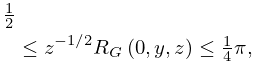
The condition for (19.24.1) and (19.24.2) serves only to identify as the smaller of the two nonzero variables of a symmetric function; it does not restrict validity.
| 19.24.1 | |||
| , | |||
| 19.24.2 | |||
| , | |||
| 19.24.3 | |||
| , . | |||
If , , and are positive, then
| 19.24.4 | |||
Inequalities for are included as the case .
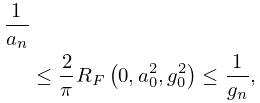
A series of successively sharper inequalities is obtained from the AGM process (§19.8(i)) with :
| 19.24.5 | |||
| , | |||
where
| 19.24.6 | ||||
Other inequalities can be obtained by applying Carlson (1966, Theorems 2 and 3) to (19.16.20)–(19.16.23). Approximations and one-sided inequalities for follow from those given in §19.9(i) for the length of an ellipse with semiaxes and , since
| 19.24.7 | |||
For , , and , the complete cases of and satisfy
| 19.24.8 | ||||
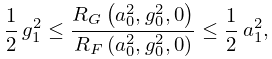
Also, with the notation of (19.24.6),
| 19.24.9 | |||
with equality iff .
§19.24(ii) Incomplete Integrals
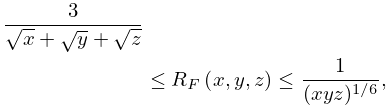
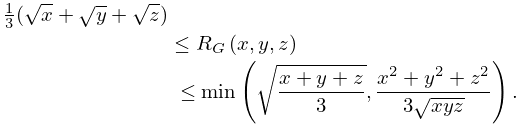
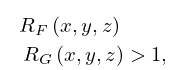
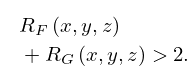
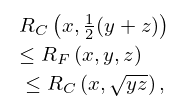
Inequalities for in Carlson (1966, Theorems 2 and 3) can be applied to (19.16.14)–(19.16.17). All variables are positive, and equality occurs iff all variables are equal.
Examples
| 19.24.10 | |||
| 19.24.11 | |||
| 19.24.12 | |||
Inequalities for and are included as special cases (see (19.16.6) and (19.16.5)).
Other inequalities for are given in Carlson (1970).
If () is real, all components of and are positive, and the components of are not all equal, then
| 19.24.13 | ||||
see Neuman (2003, (2.13)). Special cases with are (19.24.8) (because of (19.16.20), (19.16.23)), and
| 19.24.14 | ||||
The same reference also gives upper and lower bounds for symmetric integrals in terms of their elementary degenerate cases. These bounds include a sharper but more complicated lower bound than that supplied in the next result:
| 19.24.15 | |||
| , | |||
with equality iff .