§19.34 Mutual Inductance of Coaxial Circles
The mutual inductance of two coaxial circles of radius and with centers at a distance apart is given in cgs units by
| 19.34.1 | |||
where is the speed of light, and in (19.29.11),
| 19.34.2 | ||||
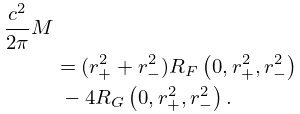
The method of §19.29(ii) uses (19.29.18), (19.29.16), and (19.29.15) to produce
| 19.34.3 | |||
where and
| 19.34.4 | |||
is the square of the maximum (upper signs) or minimum (lower signs) distance between the circles. Application of (19.29.4) and (19.29.7) with , , , and yields
| 19.34.5 | |||
or, by (19.21.3),
| 19.34.6 | |||
A simpler form of the result is
| 19.34.7 | |||
References for other inductance problems solvable in terms of elliptic integrals are given in Grover (1946, pp. 8 and 283).