8.19 Generalized Exponential Integral8.21 Generalized Sine and Cosine Integrals

§8.20 Asymptotic Expansions of \mathop{E_{{p}}\/}\nolimits\!\left(z\right)

Contents

§8.20(i) Large z

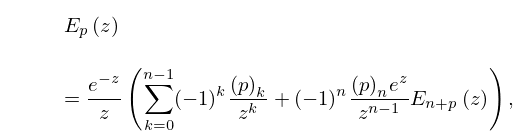
8.20.1 \mathop{E_{{p}}\/}\nolimits\!\left(z\right)=\frac{e^{{-z}}}{z}\left(\sum _{{k=0}}^{{n-1}}(-1)^{k}\frac{\left(p\right)_{{k}}}{z^{k}}+(-1)^{n}\frac{\left(p\right)_{{n}}e^{z}}{z^{{n-1}}}\mathop{E_{{n+p}}\/}\nolimits\!\left(z\right)\right), n=1,2,3,\dots.

As z\to\infty

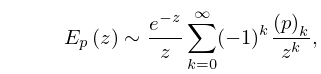
8.20.2 \mathop{E_{{p}}\/}\nolimits\!\left(z\right)\sim\frac{e^{{-z}}}{z}\sum _{{k=0}}^{\infty}(-1)^{k}\frac{\left(p\right)_{{k}}}{z^{k}}, |\mathop{\mathrm{ph}\/}\nolimits z|\leq\frac{3}{2}\pi-\delta,

and

8.20.3 \mathop{E_{{p}}\/}\nolimits\!\left(z\right)\sim\pm\frac{2\pi i}{\mathop{\Gamma\/}\nolimits\!\left(p\right)}e^{{\mp p\pi i}}z^{{p-1}}+\frac{e^{{-z}}}{z}\sum _{{k=0}}^{\infty}\frac{(-1)^{k}\left(p\right)_{{k}}}{z^{k}}, \tfrac{1}{2}\pi+\delta\leq\pm\mathop{\mathrm{ph}\/}\nolimits z\leq\tfrac{7}{2}\pi-\delta,

\delta again denoting an arbitrary small positive constant. Where the sectors of validity of (8.20.2) and (8.20.3) overlap the contribution of the first term on the right-hand side of (8.20.3) is exponentially small compared to the other contribution; compare §2.11(ii).

For an exponentially-improved asymptotic expansion of \mathop{E_{{p}}\/}\nolimits\!\left(z\right) see §2.11(iii).

§8.20(ii) Large p

For x\geq 0 and p>1 let x=\lambda p and define A_{0}(\lambda)=1,

8.20.4 A_{{k+1}}(\lambda)=(1-2k\lambda)A_{k}(\lambda)+\lambda(\lambda+1)\frac{dA_{k}(\lambda)}{d\lambda}, k=0,1,2,\dots,

so that A_{k}(\lambda) is a polynomial in \lambda of degree k-1 when k\geq 1. In particular,

8.20.5
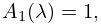
A_{1}(\lambda)=1,
A_{2}(\lambda)=1-2\lambda,
A_{3}(\lambda)=1-8\lambda+6\lambda^{2}.

Then as p\to\infty

8.20.6 \mathop{E_{{p}}\/}\nolimits\!\left(\lambda p\right)\sim\frac{e^{{-\lambda p}}}{(\lambda+1)p}\sum _{{k=0}}^{\infty}\frac{A_{k}(\lambda)}{(\lambda+1)^{{2k}}}\frac{1}{p^{k}},

uniformly for \lambda\in[0,\infty).

For further information, including extensions to complex values of x and p, see Temme (1994b, §4) and Dunster (1996b, 1997).