Digital Library of Mathematical Functions
About the Project
NIST
7 Error Functions, Dawson’s and Fresnel IntegralsProperties

§7.12 Asymptotic Expansions

Contents

§7.12(i) Complementary Error Function

As z\to\infty

7.12.1
\mathop{\mathrm{erfc}\/}\nolimits z\sim\frac{e^{{-z^{2}}}}{\sqrt{\pi}z}\sum_{{%
m=0}}^{\infty}(-1)^{m}\frac{1\cdot 3\cdot 5\cdots(2m-1)}{(2z^{2})^{m}},
\mathop{\mathrm{erfc}\/}\nolimits\!\left(-z\right)\sim 2-\frac{e^{{-z^{2}}}}{%
\sqrt{\pi}z}\sum_{{m=0}}^{\infty}(-1)^{m}\frac{1\cdot 3\cdot 5\cdots(2m-1)}{(2%
z^{2})^{m}},

both expansions being valid when |\mathop{\mathrm{ph}\/}\nolimits z|\leq\frac{3}{4}\pi-\delta (<\frac{3}{4}\pi).

When |\mathop{\mathrm{ph}\/}\nolimits z|\leq\frac{1}{4}\pi the remainder terms are bounded in magnitude by the first neglected terms, and have the same sign as these terms when \mathop{\mathrm{ph}\/}\nolimits z=0. When \frac{1}{4}\pi\leq|\mathop{\mathrm{ph}\/}\nolimits z|<\frac{1}{2}\pi the remainder terms are bounded in magnitude by \mathop{\csc\/}\nolimits\!\left(2|\mathop{\mathrm{ph}\/}\nolimits z|\right) times the first neglected terms. For these and other error bounds see Olver (1997b, pp. 109–112), with \alpha=\frac{1}{2} and z replaced by z^{2}; compare (7.11.2).

For re-expansions of the remainder terms leading to larger sectors of validity, exponential improvement, and a smooth interpretation of the Stokes phenomenon, see §§2.11(ii)2.11(iv) and use (7.11.3). (Note that some of these re-expansions themselves involve the complementary error function.)

§7.12(ii) Fresnel Integrals

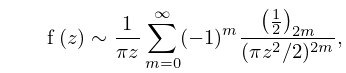
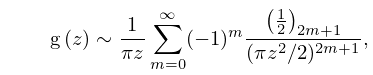
The asymptotic expansions of \mathop{C\/}\nolimits\!\left(z\right) and \mathop{S\/}\nolimits\!\left(z\right) are given by (7.5.3), (7.5.4), and

as z\to\infty in |\mathop{\mathrm{ph}\/}\nolimits z|\leq\frac{1}{2}\pi-\delta(<\frac{1}{2}\pi). The remainder terms are given by

7.12.4\mathop{\mathrm{f}\/}\nolimits\!\left(z\right)=\frac{1}{\pi z}\sum_{{m=0}}^{{n%
-1}}(-1)^{m}\frac{1\cdot 3\cdots(4m-1)}{(\pi z^{2})^{{2m}}}+R_{n}^{{(\mathop{%
\mathrm{f}\/}\nolimits)}}(z),
7.12.5\mathop{\mathrm{g}\/}\nolimits\!\left(z\right)=\frac{1}{\pi^{2}z^{3}}\sum_{{m=%
0}}^{{n-1}}(-1)^{m}\frac{1\cdot 3\cdots(4m+1)}{(\pi z^{2})^{{2m}}}+R_{n}^{{(%
\mathop{\mathrm{g}\/}\nolimits)}}(z),

where, for n=0,1,2,\dots and |\mathop{\mathrm{ph}\/}\nolimits z|<\tfrac{1}{4}\pi,

When |\mathop{\mathrm{ph}\/}\nolimits z|\leq\frac{1}{8}\pi, R_{n}^{{(\mathop{\mathrm{f}\/}\nolimits)}}(z) and R_{n}^{{(\mathop{\mathrm{g}\/}\nolimits)}}(z) are bounded in magnitude by the first neglected terms in (7.12.2) and (7.12.3), respectively, and have the same signs as these terms when \mathop{\mathrm{ph}\/}\nolimits z=0. They are bounded by |\mathop{\csc\/}\nolimits\!\left(4\mathop{\mathrm{ph}\/}\nolimits z\right)| times the first neglected terms when \frac{1}{8}\pi\leq|\mathop{\mathrm{ph}\/}\nolimits z|<\frac{1}{4}\pi.

For other phase ranges use (7.4.7) and (7.4.8). For exponentially-improved expansions use (7.5.7), (7.5.10), and §7.12(i).

§7.12(iii) Goodwin–Staton Integral

See Olver (1997b, p. 115) for an expansion of \mathop{G\/}\nolimits\!\left(z\right) with bounds for the remainder for real and complex values of z.