§36.12 Uniform Approximation of Integrals
Contents
§36.12(i) General Theory for Cuspoids
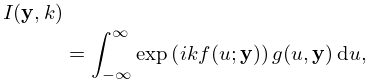
The canonical integrals (36.2.4) provide a basis for uniform asymptotic approximations of oscillatory integrals. In the cuspoid case (one integration variable)
| 36.12.1 | |||
where is a large real parameter and is a set of additional (nonasymptotic) parameters. As varies as many as (real or complex) critical points of the smooth phase function can coalesce in clusters of two or more. The function has a smooth amplitude. Also, is real analytic, and for all such that all critical points coincide. If , then we may evaluate the complex conjugate of for real values of and , and obtain by conjugation and analytic continuation. The critical points , , are defined by
| 36.12.2 | |||
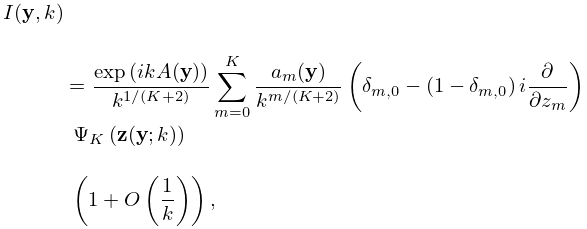
The leading-order uniform asymptotic approximation is given by
| 36.12.3 | |||
where , , are as follows. Define a mapping by relating to the normal form (36.2.1) of in the following way:
| 36.12.4 | |||
with the functions and determined by correspondence of the critical points of and . Then
| 36.12.5 | |||
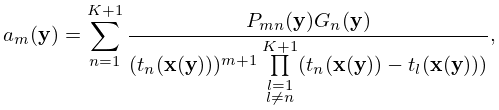
where , , are the critical points of , that is, the solutions (real and complex) of (36.4.1). Correspondence between the and the is established by the order of critical points along the real axis when and are such that these critical points are all real, and by continuation when some or all of the critical points are complex. The branch for is such that is real when is real. In consequence,
| 36.12.6 | |||
| 36.12.7 | ||||
| 36.12.8 | |||
where
| 36.12.9 | |||
and
| 36.12.10 | |||
In (36.12.10), both second derivatives vanish when critical points coalesce, but their ratio remains finite. The square roots are real and positive when is such that all the critical points are real, and are defined by analytic continuation elsewhere. The quantities are real for real when is real analytic.
This technique can be applied to generate a hierarchy of approximations for the diffraction catastrophes in (36.2.10) away from , in terms of canonical integrals for . For example, the diffraction catastrophe defined by (36.2.10), and corresponding to the Pearcey integral (36.2.14), can be approximated by the Airy function when is large, provided that and are not small. For details of this example, see Paris (1991).
For further information see Berry and Howls (1993).
§36.12(ii) Special Case
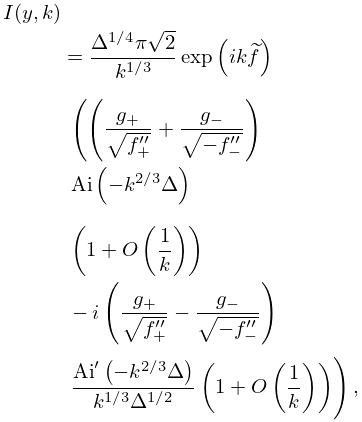
For , with a single parameter , let the two critical points of be denoted by , with for those values of for which these critical points are real. Then
| 36.12.11 | |||
where
| 36.12.12 | ||||
For and see §9.2. Branches are chosen so that is real and positive if the critical points are real, or real and negative if they are complex. The coefficients of and are real if is real and is real analytic. Also, and are chosen to be positive real when is such that both critical points are real, and by analytic continuation otherwise.