§30.14 Wave Equation in Oblate Spheroidal Coordinates
Contents
- §30.14(i) Oblate Spheroidal Coordinates
- §30.14(ii) Metric Coefficients
- §30.14(iii) Laplacian
- §30.14(iv) Separation of Variables
- §30.14(v) The Interior Dirichlet Problem for Oblate Ellipsoids
§30.14(i) Oblate Spheroidal Coordinates
Oblate spheroidal coordinates are related to Cartesian coordinates by
| 30.14.1 | ||||
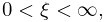
where is a positive constant. (On the use of the symbol in place of see §1.5(ii).) The -space without the -axis and the disk , corresponds to
| 30.14.2 | ||||
The coordinate surfaces are oblate ellipsoids of revolution with focal circle , . The coordinate surfaces are halves of one-sheeted hyperboloids of revolution with the same focal circle. The disk , is given by , , and the rays , are given by , .
§30.14(ii) Metric Coefficients
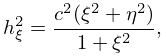
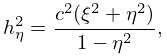
| 30.14.3 | ||||
| 30.14.4 | ||||
| 30.14.5 | ||||
§30.14(iii) Laplacian
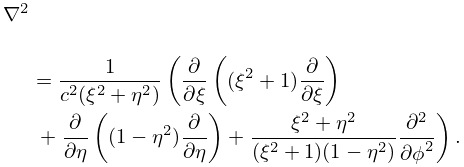
| 30.14.6 | |||
§30.14(iv) Separation of Variables
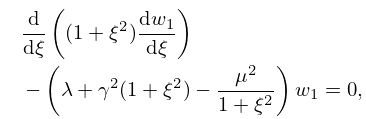
The wave equation (30.13.7), transformed to oblate spheroidal coordinates , admits solutions of the form (30.13.8), where satisfies the differential equation
| 30.14.7 | |||
and , satisfy (30.13.10) and (30.13.11), respectively, with and separation constants and . Equation (30.14.7) can be transformed to equation (30.2.1) by the substitution .
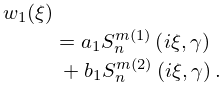
In most applications the solution has to be a single-valued function of , which requires (a nonnegative integer). Moreover, the solution has to be bounded along the -axis: this requires to be bounded when . Then for some , and the solution of (30.13.10) is given by (30.13.13). The solution of (30.14.7) is given by
| 30.14.8 | |||
§30.14(v) The Interior Dirichlet Problem for Oblate Ellipsoids
Equation (30.13.7) for together with the boundary condition on the ellipsoid given by , poses an eigenvalue problem with as spectral parameter. The eigenvalues are given by , where is determined from the condition
| 30.14.9 | |||
The corresponding eigenfunctions are then given by (30.13.8), (30.14.8), (30.13.13), (30.13.12), with .