30 Spheroidal Wave FunctionsApplications30.14 Wave Equation in Oblate Spheroidal Coordinates30.16 Methods of Computation
§30.15 Signal Analysis
Contents
- §30.15(i) Scaled Spheroidal Wave Functions
- §30.15(ii) Integral Equation
- §30.15(iii) Fourier Transform
- §30.15(iv) Orthogonality
- §30.15(v) Extremal Properties
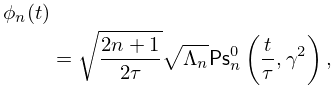
§30.15(i) Scaled Spheroidal Wave Functions
§30.15(ii) Integral Equation
| 30.15.3 | |||
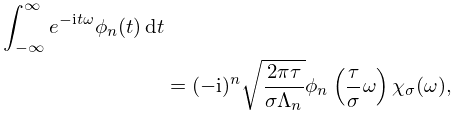
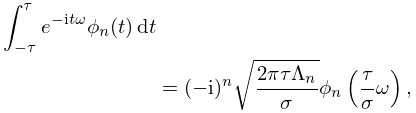
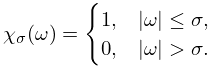
§30.15(iii) Fourier Transform
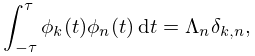
§30.15(iv) Orthogonality
| 30.15.7 | ||||
| 30.15.8 | ||||
The sequence , forms an orthonormal basis in the space of -bandlimited functions, and, after normalization, an orthonormal basis in .
§30.15(v) Extremal Properties
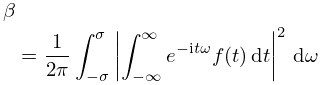
The maximum (or least upper bound) of all numbers
| 30.15.9 | |||
taken over all subject to
| 30.15.10 | ||||
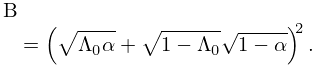
for (fixed) , is given by
| 30.15.11 | |||
or equivalently,
| 30.15.12 | |||
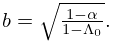
The corresponding function is given by
| 30.15.13 | ||||
If , then .