Digital Library of Mathematical Functions
About the Project
NIST
28 Mathieu Functions and Hill’s EquationHill’s Equation

§28.31 Equations of Whittaker–Hill and Ince

Contents

§28.31(i) Whittaker–Hill Equation

Hill’s equation with three terms

28.31.1W^{{\prime\prime}}+\left(A+B\mathop{\cos\/}\nolimits\!\left(2z\right)-\tfrac{1%
}{2}(kc)^{2}\mathop{\cos\/}\nolimits\!\left(4z\right)\right)W=0

and constant values of A,B,k, and c, is called the Equation of Whittaker–Hill. It has been discussed in detail by Arscott (1967) for k^{2}<0, and by Urwin and Arscott (1970) for k^{2}>0.
§28.31(ii) Equation of Ince; Ince Polynomials

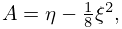
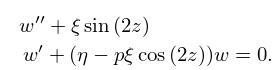
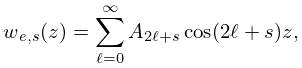
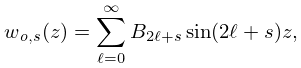
Formal 2\pi-periodic solutions can be constructed as Fourier series; compare §28.4:

where the coefficients satisfy

28.31.6
-2\eta A_{0}+(2+p)\xi A_{2}=0,
p\xi A_{0}+(4-\eta)A_{2}+\left(\tfrac{1}{2}p+2\right)\xi A_{4}=0,
(\tfrac{1}{2}p-\ell+1)\xi A_{{2\ell-2}}+\left(4\ell^{2}-\eta\right)A_{{2\ell}}%
+(\tfrac{1}{2}p+\ell+1)\xi A_{{2\ell+2}}=0,\ell\geq 2,
28.31.7
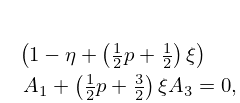
\left(1-\eta+\left(\tfrac{1}{2}p+\tfrac{1}{2}\right)\xi\right)A_{1}+\left(%
\tfrac{1}{2}p+\tfrac{3}{2}\right)\xi A_{3}=0,
(\tfrac{1}{2}p-\ell+\tfrac{1}{2})\xi A_{{2\ell-1}}+\left((2\ell+1)^{2}-\eta%
\right)A_{{2\ell+1}}+(\tfrac{1}{2}p+\ell+\tfrac{3}{2})\xi A_{{2\ell+3}}=0,\ell\geq 1,
28.31.8
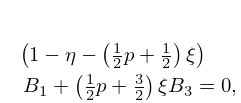
\left(1-\eta-\left(\tfrac{1}{2}p+\tfrac{1}{2}\right)\xi\right)B_{1}+\left(%
\tfrac{1}{2}p+\tfrac{3}{2}\right)\xi B_{3}=0,
(\tfrac{1}{2}p-\ell+\tfrac{1}{2})\xi B_{{2\ell-1}}+\left((2\ell+1)^{2}-\eta%
\right)B_{{2\ell+1}}+(\tfrac{1}{2}p+\ell+\tfrac{3}{2})\xi B_{{2\ell+3}}=0,\ell\geq 1,
28.31.9
(4-\eta)B_{2}+\left(\tfrac{1}{2}p+2\right)\xi B_{4}=0,
(\tfrac{1}{2}p-\ell+1)\xi B_{{2\ell-2}}+(4\ell^{2}-\eta)B_{{2\ell}}+(\tfrac{1}%
{2}p+\ell+1)\xi B_{{2\ell+2}}=0,\ell\geq 2.

When p is a nonnegative integer, the parameter \eta can be chosen so that solutions of (28.31.3) are trigonometric polynomials, called Ince polynomials. They are denoted by

28.31.10\begin{array}[]{cl}C_{{2n}}^{{2m}}(z,\xi)&\mbox{with $p=2n$},\\
C_{{2n+1}}^{{2m+1}}(z,\xi)&\mbox{with $p=2n+1$},\end{array}
28.31.11\begin{array}[]{cl}S_{{2n+1}}^{{2m+1}}(z,\xi)&\mbox{with $p=2n+1$},\\
S_{{2n+2}}^{{2m+2}}(z,\xi)&\mbox{with $p=2n+2$},\end{array}

and m=0,1,\dots,n in all cases.

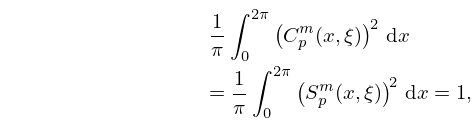
The values of \eta corresponding to C_{p}^{m}(z,\xi), S_{p}^{m}(z,\xi) are denoted by a_{p}^{m}(\xi), b_{p}^{m}(\xi), respectively. They are real and distinct, and can be ordered so that C_{p}^{m}(z,\xi) and S_{p}^{m}(z,\xi) have precisely m zeros, all simple, in 0\leq z<\pi. The normalization is given by

ambiguities in sign being resolved by requiring C_{p}^{m}(x,\xi) and {S_{p}^{m}}^{{\prime}}(x,\xi) to be continuous functions of x and positive when x=0.

If p\to\infty and \xi\to 0 in such a way that p\xi\to 2q, then in the notation of §§28.2(v) and 28.2(vi)

28.31.15
a_{p}^{m}(\xi)\to a_{m}(q),
b_{p}^{m}(\xi)\to b_{m}(q).

For proofs and further information, including convergence of the series (28.31.4), (28.31.5), see Arscott (1967).

§28.31(iii) Paraboloidal Wave Functions

With (28.31.10) and (28.31.11),

28.31.16\mathit{hc}_{p}^{m}(z,\xi)=e^{{-\frac{1}{4}\xi\mathop{\cos\/}\nolimits\!\left(%
2z\right)}}C_{p}^{m}(z,\xi),
28.31.17\mathit{hs}_{p}^{m}(z,\xi)=e^{{-\frac{1}{4}\xi\mathop{\cos\/}\nolimits\!\left(%
2z\right)}}S_{p}^{m}(z,\xi),

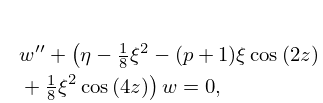
are called paraboloidal wave functions. They satisfy the differential equation

with \eta=a_{p}^{m}(\xi), \eta=b_{p}^{m}(\xi), respectively.

For m_{1}\neq m_{2},

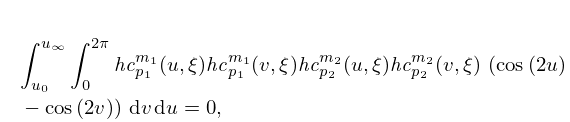
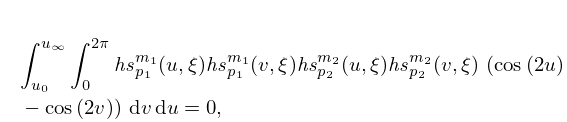
More important are the double orthogonality relations for p_{1}\neq p_{2} or m_{1}\neq m_{2} or both, given by

and

and also for all p_{1},p_{2},m_{1},m_{2}, given by

where (u_{0},u_{\infty})=(0,i\infty) when \xi>0, and (u_{0},u_{\infty})=(\tfrac{1}{2}\pi,\tfrac{1}{2}\pi+i\infty) when \xi<0.

For proofs and further integral equations see Urwin (1964, 1965).

Asymptotic Behavior

For \xi>0, the functions \mathit{hc}_{p}^{m}(z,\xi), \mathit{hs}_{p}^{m}(z,\xi) behave asymptotically as multiples of \mathop{\exp\/}\nolimits\!\left(-\tfrac{1}{4}\xi\mathop{\cos\/}\nolimits\!%
\left(2z\right)\right)\left(\mathop{\cos\/}\nolimits z\right)^{p} as z\to\pm i\infty. All other periodic solutions behave as multiples of \mathop{\exp\/}\nolimits\!\left(\tfrac{1}{4}\xi\mathop{\cos\/}\nolimits\!\left%
(2z\right)\right)(\mathop{\cos\/}\nolimits z)^{{-p-2}}.

For \xi>0, the functions \mathit{hc}_{p}^{m}(z,-\xi), \mathit{hs}_{p}^{m}(z,-\xi) behave asymptotically as multiples of \mathop{\exp\/}\nolimits\!\left(\tfrac{1}{4}\xi\mathop{\cos\/}\nolimits\!\left%
(2z\right)\right)(\mathop{\cos\/}\nolimits z)^{{-p-2}} as z\to\tfrac{1}{2}\pi\pm i\infty. All other periodic solutions behave as multiples of \mathop{\exp\/}\nolimits\!\left(-\tfrac{1}{4}\xi\mathop{\cos\/}\nolimits\!%
\left(2z\right)\right)\left(\mathop{\cos\/}\nolimits z\right)^{p}.