§28.32 Mathematical Applications
Contents
§28.32(i) Elliptical Coordinates and an Integral Relationship
If the boundary conditions in a physical problem relate to the perimeter of an ellipse, then elliptical coordinates are convenient. These are given by
| 28.32.1 | ||||
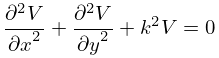
The two-dimensional wave equation
| 28.32.2 | |||
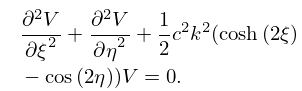
then becomes
| 28.32.3 | |||
The separated solutions can be obtained from the modified Mathieu’s equation (28.20.1) for and from Mathieu’s equation (28.2.1) for , where is the separation constant and .
This leads to integral equations and an integral relation between the solutions of Mathieu’s equation (setting , in (28.32.3)).
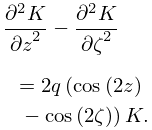
Let be a solution of Mathieu’s equation (28.2.1) and be a solution of
| 28.32.4 | |||
Also let be a curve (possibly improper) such that the quantity
| 28.32.5 | |||
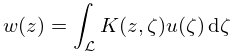
approaches the same value when tends to the endpoints of . Then
| 28.32.6 | |||
defines a solution of Mathieu’s equation, provided that (in the case of an improper curve) the integral converges with respect to uniformly on compact subsets of .
Kernels can be found, for example, by separating solutions of the wave equation in other systems of orthogonal coordinates. See Schmidt and Wolf (1979).
§28.32(ii) Paraboloidal Coordinates
The general paraboloidal coordinate system is linked with Cartesian coordinates via
| 28.32.7 | ||||
where is a parameter, , , and . When the Helmholtz equation
| 28.32.8 | |||
is separated in this system, each of the separated equations can be reduced to the Whittaker–Hill equation (28.31.1), in which are separation constants. Two conditions are used to determine . The first is the -periodicity of the solutions; the second can be their asymptotic form. For further information see Arscott (1967) for , and Urwin and Arscott (1970) for .