§26.18 Counting Techniques
Let be subsets of a set that are not necessarily disjoint. Then the number of elements in the set is
| 26.18.1 | |||
Example 1
The number of positive integers that are not divisible by any of the primes (§27.2(i)) is
| 26.18.2 | |||
Example 2
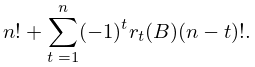
With the notation of §26.15, the number of placements of nonattacking rooks on an chessboard that avoid the squares in a specified subset is
| 26.18.3 | |||
Example 3
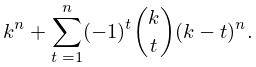
The number of ways of placing labeled objects into labeled boxes so that at least one object is in each box is
| 26.18.4 | |||
Note that this is also one of the counting problems for which a formula is given in Table 26.17.1. Elements of are labeled, elements of are labeled, and is onto.