Digital Library of Mathematical Functions
About the Project
NIST
20 Theta FunctionsComputation

§20.15 Tables

Theta functions are tabulated in Jahnke and Emde (1945, p. 45). This reference gives \mathop{\theta_{{j}}\/}\nolimits\!\left(x,q\right), j=1,2,3,4, and their logarithmic x-derivatives to 4D for x/\pi=0(.1)1, \alpha=0(9^{{\circ}})90^{{\circ}}, where \alpha is the modular angle given by

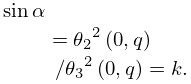
20.15.1\mathop{\sin\/}\nolimits\alpha={\mathop{\theta_{{2}}\/}\nolimits^{{2}}}\!\left%
(0,q\right)/{\mathop{\theta_{{3}}\/}\nolimits^{{2}}}\!\left(0,q\right)=k.

Spenceley and Spenceley (1947) tabulates \mathop{\theta_{{1}}\/}\nolimits\!\left(x,q\right)/\mathop{\theta_{{2}}\/}%
\nolimits\!\left(0,q\right), \mathop{\theta_{{2}}\/}\nolimits\!\left(x,q\right)/\mathop{\theta_{{2}}\/}%
\nolimits\!\left(0,q\right), \mathop{\theta_{{3}}\/}\nolimits\!\left(x,q\right)/\mathop{\theta_{{4}}\/}%
\nolimits\!\left(0,q\right), \mathop{\theta_{{4}}\/}\nolimits\!\left(x,q\right)/\mathop{\theta_{{4}}\/}%
\nolimits\!\left(0,q\right) to 12D for u=0(1^{{\circ}})90^{{\circ}}, \alpha=0(1^{{\circ}})89^{{\circ}}, where u=2x/(\pi{\mathop{\theta_{{3}}\/}\nolimits^{{2}}}\!\left(0,q\right)) and \alpha is defined by (20.15.1), together with the corresponding values of \mathop{\theta_{{2}}\/}\nolimits\!\left(0,q\right) and \mathop{\theta_{{4}}\/}\nolimits\!\left(0,q\right).

Lawden (1989, pp. 270–279) tabulates \mathop{\theta_{{j}}\/}\nolimits\!\left(x,q\right), j=1,2,3,4, to 5D for x=0(1^{{\circ}})90^{{\circ}}, q=0.1(.1)0.9, and also q to 5D for k^{2}=0(.01)1.

Tables of Neville’s theta functions \mathop{\theta_{{s}}\/}\nolimits\!\left(x,q\right), \mathop{\theta_{{c}}\/}\nolimits\!\left(x,q\right), \mathop{\theta_{{d}}\/}\nolimits\!\left(x,q\right), \mathop{\theta_{{n}}\/}\nolimits\!\left(x,q\right) (see §20.1) and their logarithmic x-derivatives are given in Abramowitz and Stegun (1964, pp. 582–585) to 9D for \varepsilon,\alpha=0(5^{{\circ}})90^{{\circ}}, where (in radian measure) \varepsilon=x/{\mathop{\theta_{{3}}\/}\nolimits^{{2}}}\!\left(0,q\right)=\pi x%
/(2\!\mathop{K\/}\nolimits\!\left(k\right)), and \alpha is defined by (20.15.1).

For other tables prior to 1961 see Fletcher et al. (1962, pp. 508–514) and Lebedev and Fedorova (1960, pp. 227–230).