§14.19 Toroidal (or Ring) Functions
Contents
- §14.19(i) Introduction
- §14.19(ii) Hypergeometric Representations
- §14.19(iii) Integral Representations
- §14.19(iv) Sums
- §14.19(v) Whipple’s Formula for Toroidal Functions
§14.19(i) Introduction
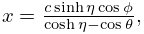
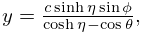
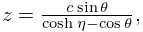
When , , , and solutions of (14.2.2) are known as toroidal or ring functions. This form of the differential equation arises when Laplace’s equation is transformed into toroidal coordinates , which are related to Cartesian coordinates by
| 14.19.1 | ||||
where the constant is a scaling factor. Most required properties of toroidal functions come directly from the results for and . In particular, for and see §14.5(v).
§14.19(ii) Hypergeometric Representations
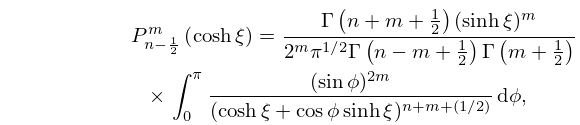
§14.19(iii) Integral Representations
With ,
| 14.19.4 | ||||
| 14.19.5 | ||||
| . | ||||
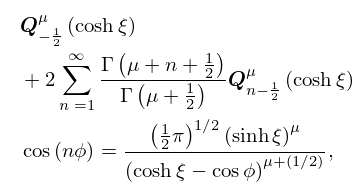
§14.19(iv) Sums
With ,
| 14.19.6 | |||
| . | |||
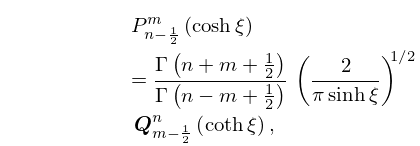
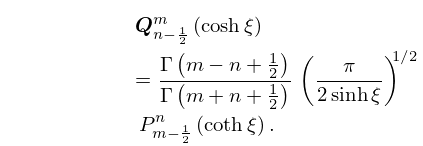
§14.19(v) Whipple’s Formula for Toroidal Functions
With ,
| 14.19.7 | |||
| 14.19.8 | |||