§12.17 Physical Applications
The main applications of PCFs in mathematical physics arise when solving the Helmholtz equation
| 12.17.1 | |||
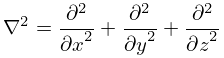
where is a constant, and is the Laplacian
| 12.17.2 | |||
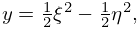
in Cartesian coordinates of three-dimensional space (§1.5(ii)). By using instead coordinates of the parabolic cylinder , defined by
| 12.17.3 | ||||
(12.17.1) becomes
| 12.17.4 | |||
Setting and separating variables, we obtain
| 12.17.5 | ||||
with arbitrary constants . The first two equations can be transformed into (12.2.2) or (12.2.3).
In a similar manner coordinates of the paraboloid of revolution transform the Helmholtz equation into equations related to the differential equations considered in this chapter. See Buchholz (1969, §4) and Morse and Feshbach (1953a, pp. 515 and 553).
Buchholz (1969) collects many results on boundary-value problems involving PCFs. Miller (1974) treats separation of variables by group theoretic methods. Dean (1966) describes the role of PCFs in quantum mechanical systems closely related to the one-dimensional harmonic oscillator.
Problems on high-frequency scattering in homogeneous media by parabolic cylinders lead to asymptotic methods for integrals involving PCFs. For this topic and other boundary-value problems see Boyd (1973), Hillion (1997), Magnus (1941), Morse and Feshbach (1953a, b), Müller (1988), Ott (1985), Rice (1954), and Shanmugam (1978).