§28.29 Definitions and Basic Properties
Contents
- §28.29(i) Hill’s Equation
- §28.29(ii) Floquet’s Theorem and the Characteristic Exponent
- §28.29(iii) Discriminant and Eigenvalues in the Real Case
§28.29(i) Hill’s Equation
A generalization of Mathieu’s equation (28.2.1) is Hill’s equation
| 28.29.1 | |||
with
| 28.29.2 | |||
and
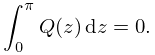
| 28.29.3 | |||
is either a continuous and real-valued function for or an analytic function of in a doubly-infinite open strip that contains the real axis. is the minimum period of .
§28.29(ii) Floquet’s Theorem and the Characteristic Exponent
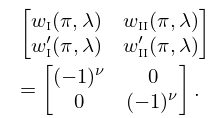
The basic solutions , are defined in the same way as in §28.2(ii) (compare (28.2.5), (28.2.6)). Then
| 28.29.4 | ||||
| 28.29.5 | ||||
Let be a real or complex constant satisfying (without loss of generality)
| 28.29.6 | |||
throughout this section. Then (28.29.1) has a nontrivial solution with the pseudoperiodic property
| 28.29.7 | |||
iff is an eigenvalue of the matrix
| 28.29.8 | |||
Equivalently,
| 28.29.9 | |||
This is the characteristic equation of (28.29.1), and is an entire function of . Given together with the condition (28.29.6), the solutions of (28.29.9) are the characteristic exponents of (28.29.1). A solution satisfying (28.29.7) is called a Floquet solution with respect to (or Floquet solution). It has the form
| 28.29.10 | |||
where the function is -periodic.
If is a solution of (28.29.9), then , comprise a fundamental pair of solutions of Hill’s equation.
If or , then (28.29.1) has a nontrivial solution which is periodic with period (when ) or (when ). Let be a solution linearly independent of . Then
| 28.29.11 | |||
where is a constant. The case is equivalent to
| 28.29.12 | |||
The solutions of period or are exceptional in the following sense. If (28.29.1) has a periodic solution with minimum period , , then all solutions are periodic with period .
Furthermore, for each solution of (28.29.1)
| 28.29.13 | |||
A nontrivial solution is either a Floquet solution with respect to , or is a Floquet solution with respect to .
In the symmetric case , is an even solution and is an odd solution; compare §28.2(ii). (28.29.9) reduces to
| 28.29.14 | |||
The cases and split into four subcases as in (28.2.21) and (28.2.22). The -periodic or -antiperiodic solutions are multiples of , respectively.
For details and proofs see Magnus and Winkler (1966, §1.3).
§28.29(iii) Discriminant and Eigenvalues in the Real Case
is assumed to be real-valued throughout this subsection.
The function
| 28.29.15 | |||
is called the discriminant of (28.29.1). It is an entire function of . Its order of growth for is exactly ; see Magnus and Winkler (1966, Chapter II, pp. 19–28).
For a given , the characteristic equation has infinitely many roots . Conversely, for a given , the value of is needed for the computation of . For this purpose the discriminant can be expressed as an infinite determinant involving the Fourier coefficients of ; see Magnus and Winkler (1966, §2.3, pp. 28–36).
To every equation (28.29.1), there belong two increasing infinite sequences of real eigenvalues:
| 28.29.16 | ||||
| 28.29.17 | ||||
In consequence, (28.29.1) has a solution of period iff , and a solution of period iff . Both and as , and interlace according to the inequalities
| 28.29.18 | |||
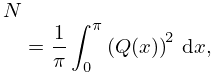
Assume that the second derivative of in (28.29.1) exists and is continuous. Then with
| 28.29.19 | |||
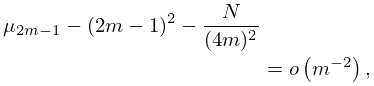
we have for
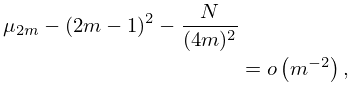
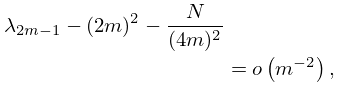
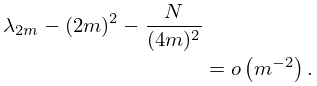
| 28.29.20 | ||||
| 28.29.21 | ||||
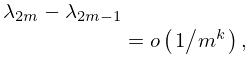
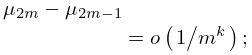
If has continuous derivatives, then as
| 28.29.22 | ||||
see Hochstadt (1963).
For further results, especially when is analytic in a strip, see Weinstein and Keller (1987).