17 q-Hypergeometric and Related FunctionsProperties17.11 Transformations of -Appell Functions17.13 Integrals
§17.12 Bailey Pairs
Bailey Transform
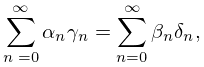
| 17.12.1 | |||
where
| 17.12.2 | ||||
Bailey Pairs
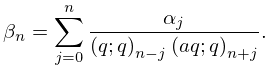
A sequence of pairs of rational functions of several variables , , is called a Bailey pair provided that for each
| 17.12.3 | |||
Weak Bailey Lemma
If is a Bailey pair, then
| 17.12.4 | |||
Strong Bailey Lemma
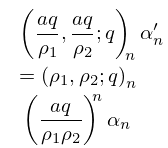
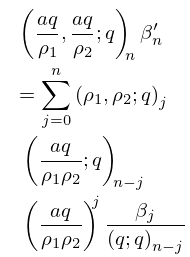
If is a Bailey pair, then so is , where
| 17.12.5 | ||||
When (17.12.5) is iterated the resulting infinite sequence of Bailey pairs is called a Bailey Chain.
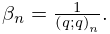
The Bailey pair that implies the Rogers–Ramanujan identities §17.2(vi) is:
| 17.12.6 | ||||