28 Mathieu Functions and Hill’s EquationMathieu Functions of Integer Order28.10 Integral Equations28.12 Definitions and Basic Properties
§28.11 Expansions in Series of Mathieu Functions
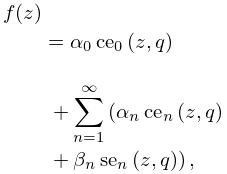
Let be a -periodic function that is analytic in an open doubly-infinite strip that contains the real axis, and be a normal value (§28.7). Then
| 28.11.1 | |||
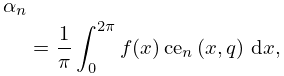
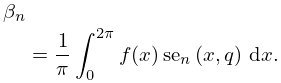
where
| 28.11.2 | ||||
The series (28.11.1) converges absolutely and uniformly on any compact subset of the strip . See Meixner and Schäfke (1954, §2.28), and for expansions in the case of the exceptional values of see Meixner et al. (1980, p. 33).