…
►With the process of solution can then be regarded as first solving the equation for (forward
elimination), followed by the solution of for (backsubstitution).
…
►In solving , we obtain by forward elimination , and by backsubstitution
.
…
►and backsubstitution is , followed by
…
…
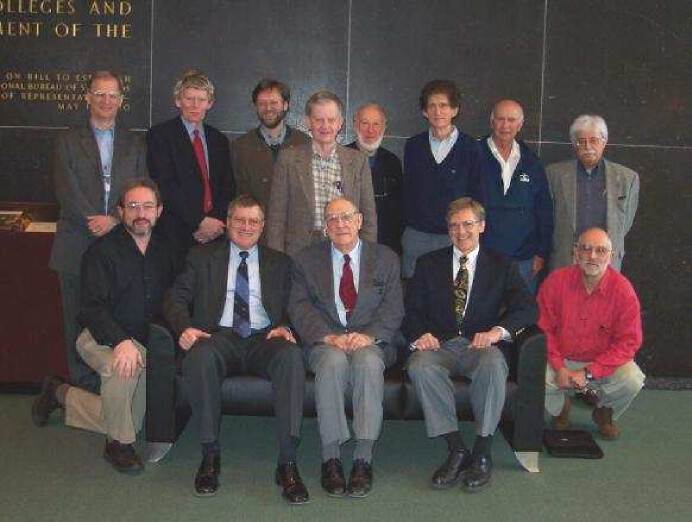
►Figure 1: The Editors and 9 of the 10 Associate Editors of the DLMF Project (photo taken at 3rd Editors Meeting, April, 2001).
…The back row, from left to right: William P.
…
…
…
►Davis left NBS in 1963 to become a faculty member in the Division of Applied Mathematics at Brown University, but during the early development of the DLMF, which started in 1998, he was invited back to give a talk and speak with DLMF project members about their plans.
…
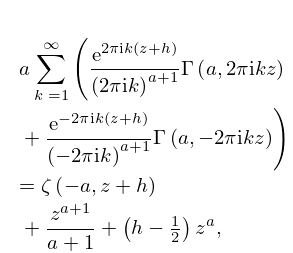
Start with and . For take integral representation (8.2.2) and
use the substitution
.
The sum and the integral can be interchanged, and the sum can be evaluated via (4.6.1).
Use integration by parts.
This will result in plus two integrals with infinitely many poles.
The residue theorem (§1.10(iv)) will give us an infinite series
which can be identified via (25.11.1). For other values of and use analytic continuation.