§10.72 Mathematical Applications
Contents
- §10.72(i) Differential Equations with Turning Points
- §10.72(ii) Differential Equations with Poles
- §10.72(iii) Differential Equations with a Double Pole and a Movable Turning Point
§10.72(i) Differential Equations with Turning Points
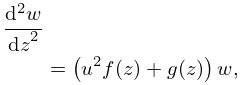
Bessel functions and modified Bessel functions are often used as approximants in the construction of uniform asymptotic approximations and expansions for solutions of linear second-order differential equations containing a parameter. The canonical form of differential equation for these problems is given by
| 10.72.1 | |||
where is a real or complex variable and is a large real or complex parameter.
Simple Turning Points
In regions in which (10.72.1) has a simple turning point , that is, and are analytic (or with weaker conditions if is a real variable) and is a simple zero of , asymptotic expansions of the solutions for large can be constructed in terms of Airy functions or equivalently Bessel functions or modified Bessel functions of order (§9.6(i)). These expansions are uniform with respect to , including the turning point and its neighborhood, and the region of validity often includes cut neighborhoods (§1.10(vi)) of other singularities of the differential equation, especially irregular singularities.
Multiple or Fractional Turning Points
If has a double zero , or more generally is a zero of order , , then uniform asymptotic approximations (but not expansions) can be constructed in terms of Bessel functions, or modified Bessel functions, of order . The number can also be replaced by any real constant in the sense that is analytic and nonvanishing at ; moreover, is permitted to have a single or double pole at . The order of the approximating Bessel functions, or modified Bessel functions, is , except in the case when has a double pole at . See §2.8(v) for references.
§10.72(ii) Differential Equations with Poles
In regions in which the function has a simple pole at and is analytic at (the case in §10.72(i)), asymptotic expansions of the solutions of (10.72.1) for large can be constructed in terms of Bessel functions and modified Bessel functions of order , where is the limiting value of as . These asymptotic expansions are uniform with respect to , including cut neighborhoods of , and again the region of uniformity often includes cut neighborhoods of other singularities of the differential equation.
§10.72(iii) Differential Equations with a Double Pole and a Movable Turning Point
In (10.72.1) assume and depend continuously on a real parameter , has a simple zero and a double pole , except for a critical value , where . Assume that whether or not , is analytic at . Then for large asymptotic approximations of the solutions can be constructed in terms of Bessel functions, or modified Bessel functions, of variable order (in fact the order depends on and ). These approximations are uniform with respect to both and , including , the cut neighborhood of , and . See §2.8(vi) for references.