…
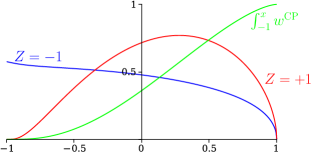
►►►Figure 18.39.2: Coulomb–Pollaczek weight functions, , (18.39.50) for , , and .
…For the weight function, blue curve, is non-zero at , but this point is also an essential singularity as the discrete parts of the weight function of (18.39.51) accumulate as , .
Magnify►In the attractive case (18.35.6_4) for the discrete parts of the weight function where with , are also simplified:
…
►
…
►For other cases there may also be, in addition to a possible integral as in (18.30.10), a finite sum of discreteweights on the negative real -axis each multiplied by the polynomial product evaluated at the corresponding values of , as in (18.2.3).
…
…
►The Askey–Wilson polynomials form a system of OP’s , , that are orthogonal with respect to a weight function on a bounded interval, possibly supplemented with discreteweights on a finite set.
…
…
►The basic ideas of Gaussian quadrature, and their extensions to non-classical weight functions, and the computation of the corresponding quadrature abscissas and weights, have led to discrete variable representations, or DVRs, of Sturm–Liouville and other differential operators.
…
…
►In addition to the orthogonal property given by Table 18.3.1, the Chebyshev polynomials , , are orthogonal on the discrete point set comprising the zeros , of :
…
►For another version of the discrete orthogonality property of the polynomials see (3.11.9).
…
►It is also related to a discrete Fourier-cosine transform, see Britanak et al. (2007).
…
►For a finite system of Jacobi polynomials is orthogonal on with weight function .
…
 ►
►