§21.5 Modular Transformations
- Permalink:
- http://dlmf.nist.gov/21.5
- See also:
- Annotations for Ch.21
Contents
§21.5(i) Riemann Theta Functions
- Keywords:
- Riemann theta functions, matrix, modular group, modular transformations, symplectic
- Notes:
- See Arnol′d (1997, p. 222) and Mumford (1983, pp. 189–210).
- Permalink:
- http://dlmf.nist.gov/21.5.i
- See also:
- Annotations for §21.5 and Ch.21
Let , , , and be matrices with integer elements such that
| 21.5.1 | |||
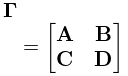
is a symplectic matrix, that is,
| 21.5.2 | |||
|
ⓘ
| |||
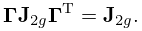
Then
| 21.5.3 | |||
|
ⓘ
| |||

and
| 21.5.4 | |||
|
ⓘ
| |||
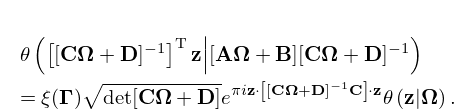
Here is an eighth root of unity, that is, . For general , it is difficult to decide which root needs to be used. The choice depends on , but is independent of and . Equation (21.5.4) is the modular transformation property for Riemann theta functions.
The modular transformations form a group under the composition of such transformations, the modular group, which is generated by simpler transformations, for which is determinate:
| 21.5.5 | |||
|
ⓘ
| |||
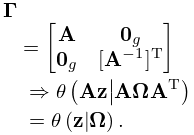
( invertible with integer elements.)
| 21.5.6 | |||
|
ⓘ
| |||
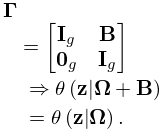
( symmetric with integer elements and even diagonal elements.)
| 21.5.7 | |||
|
ⓘ
| |||
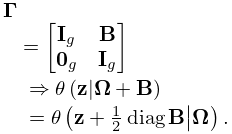
( symmetric with integer elements.) See Heil (1995, p. 24). For a matrix we define , as a column vector with the diagonal entries as elements.
| 21.5.8 | ||||
|
ⓘ
| ||||
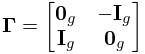


where the square root assumes its principal value.
§21.5(ii) Riemann Theta Functions with Characteristics
- Keywords:
- Riemann theta functions, Riemann theta functions with characteristics, modular transformations
- Notes:
- See Igusa (1972, pp. 78–85).
- Referenced by:
- §20.11(iv)
- Permalink:
- http://dlmf.nist.gov/21.5.ii
- See also:
- Annotations for §21.5 and Ch.21
| 21.5.9 | |||
|
ⓘ
| |||
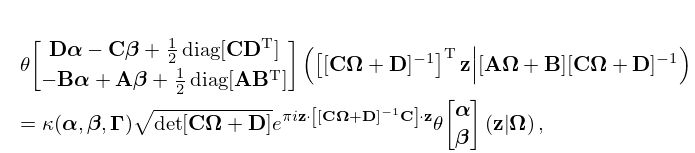
where is a complex number that depends on , , and . However, is independent of and . For explicit results in the case , see §20.7(viii).