§19.8 Quadratic Transformations
- Keywords:
- Legendre’s elliptic integrals, quadratic transformations
- Permalink:
- http://dlmf.nist.gov/19.8
- See also:
- Annotations for Ch.19
Contents
- §19.8(i) Gauss’s Arithmetic-Geometric Mean (AGM)
- §19.8(ii) Landen Transformations
- §19.8(iii) Gauss Transformation
§19.8(i) Gauss’s Arithmetic-Geometric Mean (AGM)
- Defines:
- : arithmetic-geometric mean
- Keywords:
- Legendre’s elliptic integrals, arithmetic-geometric mean, integral representations
- Notes:
- See Cox (1984, 1985), Borwein and Borwein (1987, Chapter 1). To prove the second equality in (19.8.4), put . (19.8.7) is derived from (19.22.12) and (19.25.14), and (19.8.9) is derived from (19.6.5) and (19.8.7); see also Carlson (2002).
- Referenced by:
- §19.22(ii), §19.24(i), §19.36(ii), item 1
- Permalink:
- http://dlmf.nist.gov/19.8.i
- See also:
- Annotations for §19.8 and Ch.19
When and are positive numbers, define
| 19.8.1 | ||||
| , | ||||
| . | ||||
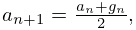

As , and converge to a common limit called the AGM (Arithmetic-Geometric Mean) of and . By symmetry in and we may assume and define
| 19.8.2 | |||
|
ⓘ
| |||
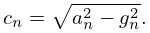
Then
| 19.8.3 | |||
|
ⓘ
| |||
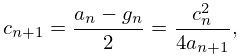
showing that the convergence of to 0 and of and to is quadratic in each case.
The AGM has the integral representations
| 19.8.4 | |||
|
ⓘ
| |||

The first of these shows that
| 19.8.5 | |||
| . | |||
|
ⓘ
| |||
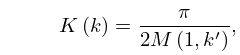
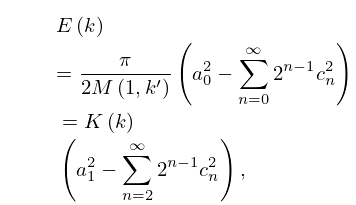
The AGM appears in
| 19.8.6 | |||
| , , , | |||
|
ⓘ
| |||
and in
| 19.8.7 | |||
| , , | |||
|
ⓘ
| |||
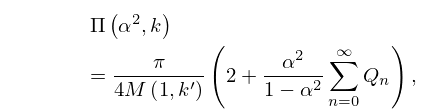
where , , , , and
| 19.8.8 | ||||
| , | ||||
| . | ||||
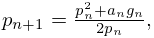
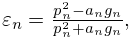
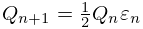
Again, and converge quadratically to and 0, respectively, and converges to 0 faster than quadratically. If , then the Cauchy principal value is
| 19.8.9 | |||
| , , | |||
|
ⓘ
| |||

where (19.8.8) still applies, but with
| 19.8.10 | |||
|
ⓘ
| |||

§19.8(ii) Landen Transformations
Descending Landen Transformation
- Keywords:
- Landen transformations, Legendre’s elliptic integrals, descending
- See also:
- Annotations for §19.8(ii), §19.8 and Ch.19
Let
| 19.8.11 | ||||
|
ⓘ
| ||||
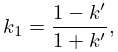
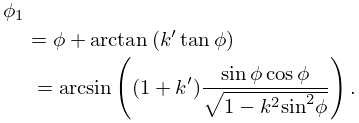
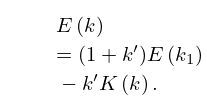
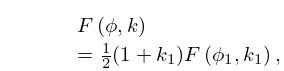
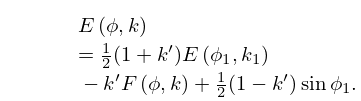
(Note that and imply and , and also that implies .) Then
| 19.8.12 | ||||
|
ⓘ
| ||||
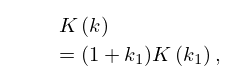
| 19.8.13 | ||||
|
ⓘ
| ||||
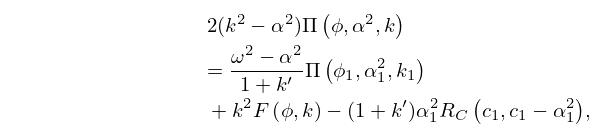
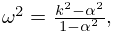
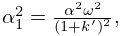
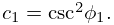
where
| 19.8.15 | ||||
|
ⓘ
| ||||
Ascending Landen Transformation
- Keywords:
- Landen transformations, Legendre’s elliptic integrals, ascending
- See also:
- Annotations for §19.8(ii), §19.8 and Ch.19
Let
| 19.8.16 | ||||
|
ⓘ
| ||||

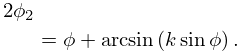
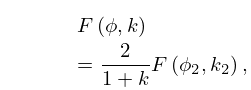
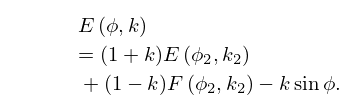
(Note that and imply and .) Then
| 19.8.17 | ||||
|
ⓘ
| ||||
§19.8(iii) Gauss Transformation
- Keywords:
- Gauss transformation, Legendre’s elliptic integrals
- Notes:
- See Cazenave (1969, pp. 114–119 and 126–127).
- Referenced by:
- §19.15
- Permalink:
- http://dlmf.nist.gov/19.8.iii
- See also:
- Annotations for §19.8 and Ch.19
We consider only the descending Gauss transformation because its (ascending) inverse moves closer to the singularity at . Let
| 19.8.18 | ||||
|
ⓘ
| ||||



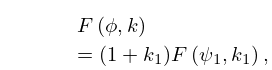
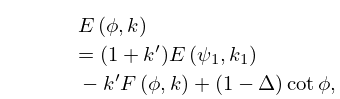
(Note that and imply and , and also that implies , thus preserving completeness.) Then
| 19.8.19 | ||||
|
ⓘ
| ||||
| 19.8.20 | |||
|
ⓘ
| |||
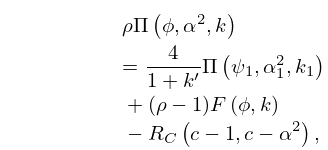
where
| 19.8.21 | ||||
|
ⓘ
| ||||



If , then is pure imaginary.