§14.21 Definitions and Basic Properties
- Referenced by:
- §14.2(ii)
- Permalink:
- http://dlmf.nist.gov/14.21
- See also:
- Annotations for Ch.14
Contents
- §14.21(i) Associated Legendre Equation
- §14.21(ii) Numerically Satisfactory Solutions
- §14.21(iii) Properties
§14.21(i) Associated Legendre Equation
- Defines:
- : associated Legendre function of the first kind, : associated Legendre function of the second kind and : Olver’s associated Legendre function
- Keywords:
- Olver’s, Olver’s associated Legendre function, analytic properties, associated Legendre equation, associated Legendre functions, definitions, integer order, principal values (or branches), standard solutions
- Notes:
- See Olver (1997b, p. 169).
- Referenced by:
- §10.43(iv), §10.54, §14.25, §15.9(iv)
- Permalink:
- http://dlmf.nist.gov/14.21.i
- See also:
- Annotations for §14.21 and Ch.14
| 14.21.1 | |||
|
ⓘ
| |||
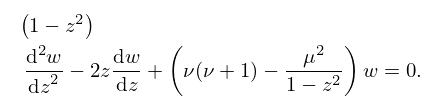
Standard solutions: the associated Legendre functions , , , and . and exist for all values of , , and , except possibly and , which are branch points (or poles) of the functions, in general. When is complex , , and are defined by (14.3.6)–(14.3.10) with replaced by : the principal branches are obtained by taking the principal values of all the multivalued functions appearing in these representations when , and by continuity elsewhere in the -plane with a cut along the interval ; compare §4.2(i). The principal branches of and are real when , and .
§14.21(ii) Numerically Satisfactory Solutions
- Keywords:
- associated Legendre equation, numerically satisfactory solutions
- Notes:
- See Olver (1997b, p. 172).
- Permalink:
- http://dlmf.nist.gov/14.21.ii
- See also:
- Annotations for §14.21 and Ch.14
When and , a numerically satisfactory pair of solutions of (14.21.1) in the half-plane is given by and .
§14.21(iii) Properties
- Keywords:
- Wronskians, associated Legendre functions, behavior at singularities, connection formulas, generating functions, hypergeometric representations, integer degree and order, recurrence relations
- Notes:
- See Erdélyi et al. (1953a, Chapter 3) and Olver (1997b, Chapter 5, §§12–14).
- Referenced by:
- §15.9(iv)
- Permalink:
- http://dlmf.nist.gov/14.21.iii
- See also:
- Annotations for §14.21 and Ch.14
Many of the properties stated in preceding sections extend immediately from the -interval to the cut -plane . This includes, for example, the Wronskian relations (14.2.7)–(14.2.11); hypergeometric representations (14.3.6)–(14.3.10) and (14.3.15)–(14.3.20); results for integer orders (14.6.3)–(14.6.5), (14.6.7), (14.6.8), (14.7.6), (14.7.7), and (14.7.11)–(14.7.16); behavior at singularities (14.8.7)–(14.8.16); connection formulas (14.9.11)–(14.9.16); recurrence relations (14.10.3)–(14.10.7). The generating function expansions (14.7.19) (with replaced by ) and (14.7.22) apply when ; (14.7.21) (with replaced by ) applies when .