§14.2 Differential Equations
- Referenced by:
- §14.2(ii)
- Permalink:
- http://dlmf.nist.gov/14.2
- See also:
- Annotations for Ch.14
Contents
- §14.2(i) Legendre’s Equation
- §14.2(ii) Associated Legendre Equation
- §14.2(iii) Numerically Satisfactory Solutions
- §14.2(iv) Wronskians and Cross-Products
§14.2(i) Legendre’s Equation
- Keywords:
- Legendre’s equation, standard solutions
- Notes:
- See Olver (1997b, p. 169).
- Permalink:
- http://dlmf.nist.gov/14.2.i
- See also:
- Annotations for §14.2 and Ch.14
| 14.2.1 | |||
|
ⓘ
| |||

Standard solutions: , , , , , . and are real when and , and and are real when and .
§14.2(ii) Associated Legendre Equation
- Defines:
- : Ferrers function of the first kind, : Ferrers function of the second kind, : Legendre function of the first kind, : Legendre function of the second kind and : Olver’s associated Legendre function
- Keywords:
- Ferrers functions, associated Legendre equation, associated Legendre functions, differential equation, standard solutions
- Notes:
- See Olver (1997b, p. 169).
- Referenced by:
- Erratum (V1.0.5) for Subsection 14.2(ii)
- Permalink:
- http://dlmf.nist.gov/14.2.ii
- Errata (effective with 1.0.5):
-
Originally it was stated, incorrectly, that
is real when and
. This statement is true only for
and .
Reported 2012-07-18 by Hans Volkmer and Howard Cohl
- See also:
- Annotations for §14.2 and Ch.14
| 14.2.2 | |||
|
ⓘ
| |||
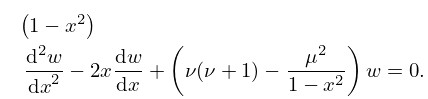
Standard solutions: , , , , , , , .
(14.2.2) reduces to (14.2.1) when . Ferrers functions and the associated Legendre functions are related to the Legendre functions by the equations , , , , .
, , and are real when , , and , and ; and are real when and , and .
§14.2(iii) Numerically Satisfactory Solutions
- Keywords:
- associated Legendre equation, exponent pairs, numerically satisfactory solutions, singularities
- Notes:
- See Olver (1997b, p. 172) for the pair and . The result for and follows from the fact that when , is recessive as and is recessive as ; see §14.8(i).
- Referenced by:
- Erratum (V1.0.22) for Subsection 14.2(iii)
- Permalink:
- http://dlmf.nist.gov/14.2.iii
- Correction (effective with 1.0.22):
-
Originally the exponents of the associated Legendre differential equation
(14.2.2) at infinity were given incorrectly by
. These were replaced by .
Suggested 2019-01-30 by Hans Volkmer
- See also:
- Annotations for §14.2 and Ch.14
Equation (14.2.2) has regular singularities at , , and , with exponent pairs , , and , respectively; compare §2.7(i).
When , and , and are linearly independent, and when they are recessive at and , respectively. Hence they comprise a numerically satisfactory pair of solutions (§2.7(iv)) of (14.2.2) in the interval . When , or , and are linearly dependent, and in these cases either may be paired with almost any linearly independent solution to form a numerically satisfactory pair.
When and , and are linearly independent, and recessive at and , respectively. Hence they comprise a numerically satisfactory pair of solutions of (14.2.2) in the interval . With the same conditions, and comprise a numerically satisfactory pair of solutions in the interval .
§14.2(iv) Wronskians and Cross-Products
- Keywords:
- Ferrers functions, Wronskians, associated Legendre functions, cross-products
- Notes:
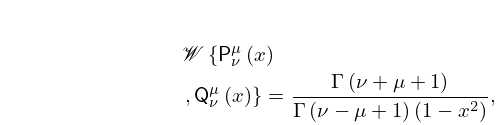
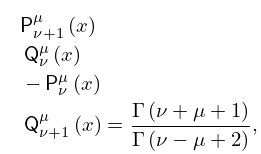
- For (14.2.4) and (14.2.5) see Olver (1997b, p. 172). The other results may be derived in a similar manner, or by application of the connection formulas in §14.9.
- Permalink:
- http://dlmf.nist.gov/14.2.iv
- See also:
- Annotations for §14.2 and Ch.14
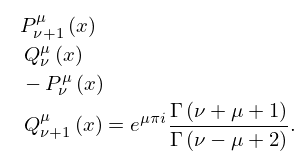
| 14.2.3 | |||
|
ⓘ
| |||

| 14.2.4 | |||
|
ⓘ
| |||
| 14.2.5 | |||
|
ⓘ
| |||
| 14.2.6 | ||||
|
ⓘ
| ||||
| 14.2.7 | ||||
|
ⓘ
| ||||
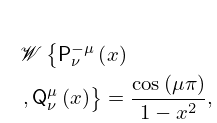
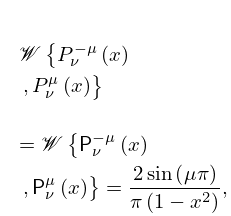
| 14.2.8 | |||
|
ⓘ
| |||
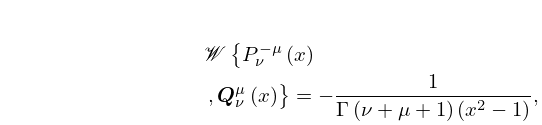
| 14.2.9 | |||
|
ⓘ
| |||
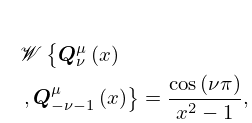
| 14.2.10 | |||
|
ⓘ
| |||
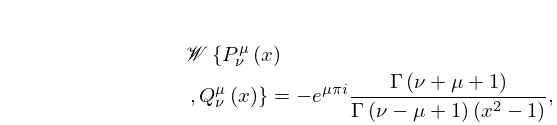
| 14.2.11 | |||
|
ⓘ
| |||