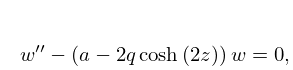
relation to Fuchsian equation
(0.004 seconds)
1—10 of 920 matching pages
1: 29.2 Differential Equations
§29.2 Differential Equations
►§29.2(i) Lamé’s Equation
… ►§29.2(ii) Other Forms
… ►For the Weierstrass function see §23.2(ii). … ►2: 30.2 Differential Equations
§30.2 Differential Equations
►§30.2(i) Spheroidal Differential Equation
… ► … ►With Equation (30.2.1) changes to … ►If , Equation (30.2.2) reduces to the Mathieu equation; see (28.2.1). …3: 31.2 Differential Equations
§31.2 Differential Equations
►§31.2(i) Heun’s Equation
►
31.2.1
.
…
►
§31.2(v) Heun’s Equation Automorphisms
… ►Composite Transformations
…4: 15.10 Hypergeometric Differential Equation
§15.10 Hypergeometric Differential Equation
►§15.10(i) Fundamental Solutions
►
15.10.1
►This is the hypergeometric differential equation.
…
►
…
5: 32.2 Differential Equations
§32.2 Differential Equations
… ►The six Painlevé equations – are as follows: … ►The six equations are sometimes referred to as the Painlevé transcendents, but in this chapter this term will be used only for their solutions. … ►An equation is said to have the Painlevé property if all its solutions are free from movable branch points; the solutions may have movable poles or movable isolated essential singularities (§1.10(iii)), however. … ►The fifty equations can be reduced to linear equations, solved in terms of elliptic functions (Chapters 22 and 23), or reduced to one of –. …6: 28.2 Definitions and Basic Properties
…
►
§28.2(i) Mathieu’s Equation
… ►
28.2.1
…
►This is the characteristic equation of Mathieu’s equation (28.2.1).
…
►leads to a Floquet solution.
…
►
§28.2(vi) Eigenfunctions
…7: 28.20 Definitions and Basic Properties
…
►
§28.20(i) Modified Mathieu’s Equation
… ►
28.20.1
…
►
§28.20(ii) Solutions , , , ,
… ►Then from §2.7(ii) it is seen that equation (28.20.2) has independent and unique solutions that are asymptotic to as in the respective sectors , being an arbitrary small positive constant. … ►§28.20(iv) Radial Mathieu Functions ,
…8: 31.14 General Fuchsian Equation
§31.14 General Fuchsian Equation
►§31.14(i) Definitions
►The general second-order Fuchsian equation with regular singularities at , , and at , is given by … ►Normal Form
… ►An algorithm given in Kovacic (1986) determines if a given (not necessarily Fuchsian) second-order homogeneous linear differential equation with rational coefficients has solutions expressible in finite terms (Liouvillean solutions). …9: 16.25 Methods of Computation
…
►Methods for computing the functions of the present chapter include power series, asymptotic expansions, integral representations, differential equations, and recurrence relations.
They are similar to those described for confluent hypergeometric functions, and hypergeometric functions in §§13.29 and 15.19.
There is, however, an added feature in the numerical solution of differential equations and difference equations (recurrence relations).
…Instead a boundary-value problem needs to be formulated and solved.
…