logarithm
(0.001 seconds)
1—10 of 407 matching pages
1: 6.2 Definitions and Interrelations
…
►
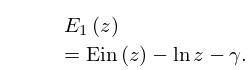
§6.2(i) Exponential and Logarithmic Integrals
… ►As in the case of the logarithm (§4.2(i)) there is a cut along the interval and the principal value is two-valued on . … ►
6.2.4
…
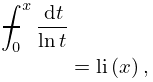
►The logarithmic integral is defined by
►
6.2.8
.
…

2: 4.11 Sums
§4.11 Sums
►For infinite series involving logarithms and/or exponentials, see Gradshteyn and Ryzhik (2015, Chapter 1), Hansen (1975, §44), and Prudnikov et al. (1986a, Chapter 5).3: 4.12 Generalized Logarithms and Exponentials
§4.12 Generalized Logarithms and Exponentials
►A generalized exponential function satisfies the equations …Its inverse is called a generalized logarithm. It, too, is strictly increasing when , and … ►For analytic generalized logarithms, see Kneser (1950).4: 4.2 Definitions
…
►
§4.2(i) The Logarithm
►The general logarithm function is defined by … ► … ►§4.2(ii) Logarithms to a General Base
… ►Natural logarithms have as base the unique positive number …5: 4.10 Integrals
…
►
§4.10(i) Logarithms
… ►
4.10.4
…
►
4.10.7
.
…
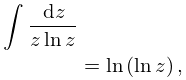
►For see §6.2(i).
…
►Extensive compendia of indefinite and definite integrals of logarithms and exponentials include Apelblat (1983, pp. 16–47), Bierens de Haan (1939), Gröbner and Hofreiter (1949, pp. 107–116), Gröbner and Hofreiter (1950, pp. 52–90), Gradshteyn and Ryzhik (2015, Chapters 2–4), and Prudnikov et al. (1986a, §§1.3, 1.6, 2.3, 2.6).
6: 4.8 Identities
…
►
§4.8(i) Logarithms
… ►This is interpreted that every value of is one of the values of , and vice versa. … ►
4.8.10
…
►where the integer is chosen so that .
►

4.8.13
.
…

7: 5.10 Continued Fractions

8: 27.12 Asymptotic Formulas: Primes
…
►
27.12.1
►
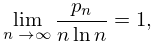
27.12.2
.
…
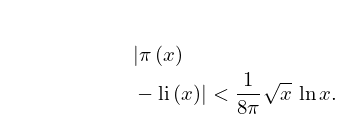
►For the logarithmic integral see (6.2.8).
…
►
changes sign infinitely often as ; see Littlewood (1914), Bays and Hudson (2000).
…
►
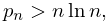
27.12.7
…