functions
(0.001 seconds)
1—10 of 959 matching pages
1: 9.1 Special Notation
…
►(For other notation see Notation for the Special Functions.)
►
►
►The main functions treated in this chapter are the Airy functions
and , and the Scorer functions
and (also known as inhomogeneous Airy functions).
►Other notations that have been used are as follows: and for and (Jeffreys (1928), later changed to and ); , (Fock (1945)); (Szegő (1967, §1.81)); , (Tumarkin (1959)).
| nonnegative integer, except in §9.9(iii). | |
| … | |
2: 31.1 Special Notation
…
►(For other notation see Notation for the Special Functions.)
►
►
►The main functions treated in this chapter are , , , and the polynomial .
…Sometimes the parameters are suppressed.
| , | real variables. |
|---|---|
| … | |
3: 23.15 Definitions
§23.15 Definitions
►§23.15(i) General Modular Functions
… ►Elliptic Modular Function
… ►Dedekind’s Eta Function (or Dedekind Modular Function)
… ►4: 5.15 Polygamma Functions
§5.15 Polygamma Functions
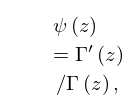
►The functions , , are called the polygamma functions. In particular, is the trigamma function; , , are the tetra-, penta-, and hexagamma functions respectively. Most properties of these functions follow straightforwardly by differentiation of properties of the psi function. … ►For see §24.2(i). …5: 5.2 Definitions
…
►
§5.2(i) Gamma and Psi Functions
►Euler’s Integral
►
5.2.1
.
…
►It is a meromorphic function with no zeros, and with simple poles of residue at .
…
►

5.2.2
.
…
6: 9.12 Scorer Functions
7: 14.19 Toroidal (or Ring) Functions
§14.19 Toroidal (or Ring) Functions
►§14.19(i) Introduction
… ►§14.19(ii) Hypergeometric Representations
… ►§14.19(iv) Sums
… ►§14.19(v) Whipple’s Formula for Toroidal Functions
…8: 11.9 Lommel Functions
§11.9 Lommel Functions
… ► ►Reflection Formulas
… ►§11.9(ii) Expansions in Series of Bessel Functions
… ►9: 20.2 Definitions and Periodic Properties
…
►

