About the Project

branch

AdvancedHelp

(0.000 seconds)

1—10 of 202 matching pages

1: 4.2 Definitions
This is a multivalued function of z with branch point at z = 0 . The principal value, or principal branch, is defined by … Most texts extend the definition of the principal value to include the branch cutIn all other cases, z a is a multivalued function with branch point at z = 0 . … This result is also valid when z a has its principal value, provided that the branch of Ln w satisfies …
2: 6.15 Sums
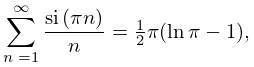
6.15.2 n = 1 si ( π n ) n = 1 2 π ( ln π 1 ) ,
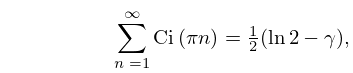
6.15.3 n = 1 ( 1 ) n Ci ( 2 π n ) = 1 ln 2 1 2 γ ,
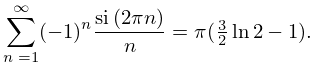
6.15.4 n = 1 ( 1 ) n si ( 2 π n ) n = π ( 3 2 ln 2 1 ) .
3: 4.10 Integrals
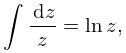
4.10.1 d z z = ln z ,
4.10.2 ln z d z = z ln z z ,
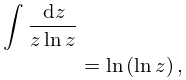
4.10.4 d z z ln z = ln ( ln z ) ,
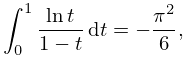
4.10.5 0 1 ln t 1 t d t = π 2 6 ,
4.10.6 0 1 ln t 1 + t d t = π 2 12 ,
4: 10.2 Definitions
§10.2(ii) Standard Solutions
The principal branch corresponds to the principal branches of J ± ν ( z ) in (10.2.3) and (10.2.4), with a cut in the z -plane along the interval ( , 0 ] . … Each solution has a branch point at z = 0 for all ν . …
Branch Conventions
5: 28.7 Analytic Continuation of Eigenvalues
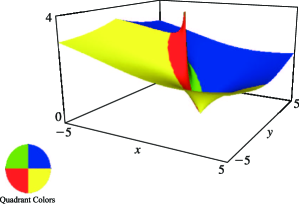
The only singularities are algebraic branch points, with a n ( q ) and b n ( q ) finite at these points. The number of branch points is infinite, but countable, and there are no finite limit points. …The branch points are called the exceptional values, and the other points normal values. … For a visualization of the first branch point of a 0 ( i q ^ ) and a 2 ( i q ^ ) see Figure 28.7.1. …
6: 4.37 Inverse Hyperbolic Functions
Elsewhere on the integration paths in (4.37.1) and (4.37.2) the branches are determined by continuity. … Arcsinh z and Arccsch z have branch points at z = ± i ; the other four functions have branch points at z = ± 1 . … The principal values (or principal branches) of the inverse sinh , cosh , and tanh are obtained by introducing cuts in the z -plane as indicated in Figure 4.37.1(i)-(iii), and requiring the integration paths in (4.37.1)–(4.37.3) not to cross these cuts. …The principal branches are denoted by arcsinh , arccosh , arctanh respectively. … For more concrete principal branch expressions for inverse hyperbolic functions see Dempsey (2025). …
7: 4.6 Power Series
4.6.1 ln ( 1 + z ) = z 1 2 z 2 + 1 3 z 3 , | z | 1 , z 1 ,
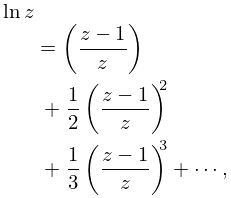
4.6.2 ln z = ( z 1 z ) + 1 2 ( z 1 z ) 2 + 1 3 ( z 1 z ) 3 + , z 1 2 ,
4.6.3 ln z = ( z 1 ) 1 2 ( z 1 ) 2 + 1 3 ( z 1 ) 3 , | z 1 | 1 , z 0 ,
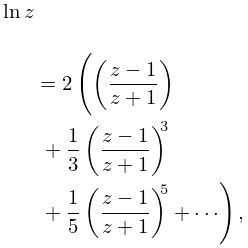
4.6.4 ln z = 2 ( ( z 1 z + 1 ) + 1 3 ( z 1 z + 1 ) 3 + 1 5 ( z 1 z + 1 ) 5 + ) , z 0 , z 0 ,
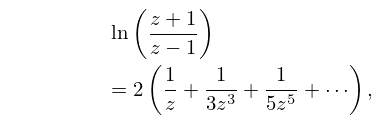
4.6.5 ln ( z + 1 z 1 ) = 2 ( 1 z + 1 3 z 3 + 1 5 z 5 + ) , | z | 1 , z ± 1 ,
8: 4.13 Lambert W -Function
We call the increasing solution for which W ( z ) W ( e 1 ) = 1 the principal branch and denote it by W 0 ( z ) . … Other solutions of (4.13.1) are other branches of W ( z ) . … W 0 ( z ) is a single-valued analytic function on ( , e 1 ] , real-valued when z > e 1 , and has a square root branch point at z = e 1 . …The other branches W k ( z ) are single-valued analytic functions on ( , 0 ] , have a logarithmic branch point at z = 0 , and, in the case k = ± 1 , have a square root branch point at z = e 1 0 i respectively. … where t 0 for W 0 , t 0 for W ± 1 on the relevant branch cuts, …
9: 6.6 Power Series
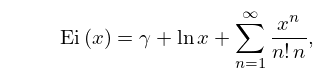
6.6.1 Ei ( x ) = γ + ln x + n = 1 x n n ! n , x > 0 .
6.6.2 E 1 ( z ) = γ ln z n = 1 ( 1 ) n z n n ! n .
6.6.6 Ci ( z ) = γ + ln z + n = 1 ( 1 ) n z 2 n ( 2 n ) ! ( 2 n ) .
10: 14.24 Analytic Continuation
Let s be an arbitrary integer, and P ν μ ( z e s π i ) and 𝑸 ν μ ( z e s π i ) denote the branches obtained from the principal branches by making 1 2 s circuits, in the positive sense, of the ellipse having ± 1 as foci and passing through z . … Next, let P ν , s μ ( z ) and 𝑸 ν , s μ ( z ) denote the branches obtained from the principal branches by encircling the branch point 1 (but not the branch point 1 ) s times in the positive sense. … For fixed z , other than ± 1 or , each branch of P ν μ ( z ) and 𝑸 ν μ ( z ) is an entire function of each parameter ν and μ . …