About the Project

bilateral

AdvancedHelp

(0.000 seconds)

9 matching pages

1: 17.18 Methods of Computation
§17.18 Methods of Computation
2: 17.1 Special Notation
§17.1 Special Notation
The main functions treated in this chapter are the basic hypergeometric (or q -hypergeometric) function ϕ s r ( a 1 , a 2 , , a r ; b 1 , b 2 , , b s ; q , z ) , the bilateral basic hypergeometric (or bilateral q -hypergeometric) function ψ s r ( a 1 , a 2 , , a r ; b 1 , b 2 , , b s ; q , z ) , and the q -analogs of the Appell functions Φ ( 1 ) ( a ; b , b ; c ; q ; x , y ) , Φ ( 2 ) ( a ; b , b ; c , c ; q ; x , y ) , Φ ( 3 ) ( a , a ; b , b ; c ; q ; x , y ) , and Φ ( 4 ) ( a , b ; c , c ; q ; x , y ) . …
3: 17.8 Special Cases of ψ r r Functions
§17.8 Special Cases of ψ r r Functions
Ramanujan’s ψ 1 1 Summation
These identities are all given in terms of sums and products of basic bilateral hypergeometric series.
Bailey’s Bilateral Summations
For similar formulas see Verma and Jain (1983).
4: 17.10 Transformations of ψ r r Functions
§17.10 Transformations of ψ r r Functions
17.10.1 ψ 2 2 ( a , b c , d ; q , z ) = ( a z , d / a , c / b , d q / ( a b z ) ; q ) ( z , d , q / b , c d / ( a b z ) ; q ) ψ 2 2 ( a , a b z / d a z , c ; q , d a ) ,
17.10.2 ψ 2 2 ( a , b c , d ; q , z ) = ( a z , b z , c q / ( a b z ) , d q / ( a b z ) ; q ) ( q / a , q / b , c , d ; q ) ψ 2 2 ( a b z / c , a b z / d a z , b z ; q , c d a b z ) .
17.10.3 ψ 8 8 ( q a 1 2 , q a 1 2 , c , d , e , f , a q n , q n a 1 2 , a 1 2 , a q / c , a q / d , a q / e , a q / f , q n + 1 , a q n + 1 ; q , a 2 q 2 n + 2 c d e f ) = ( a q , q / a , a q / ( c d ) , a q / ( e f ) ; q ) n ( q / c , q / d , a q / e , a q / f ; q ) n ψ 4 4 ( e , f , a q n + 1 / ( c d ) , q n a q / c , a q / d , q n + 1 , e f / ( a q n ) ; q , q ) ,
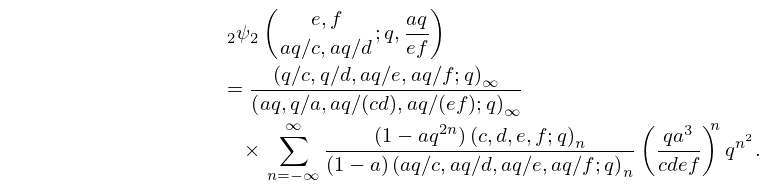
17.10.4 ψ 2 2 ( e , f a q / c , a q / d ; q , a q e f ) = ( q / c , q / d , a q / e , a q / f ; q ) ( a q , q / a , a q / ( c d ) , a q / ( e f ) ; q ) n = ( 1 a q 2 n ) ( c , d , e , f ; q ) n ( 1 a ) ( a q / c , a q / d , a q / e , a q / f ; q ) n ( q a 3 c d e f ) n q n 2 .
5: 17.4 Basic Hypergeometric Functions
§17.4 Basic Hypergeometric Functions
§17.4(ii) ψ s r Functions
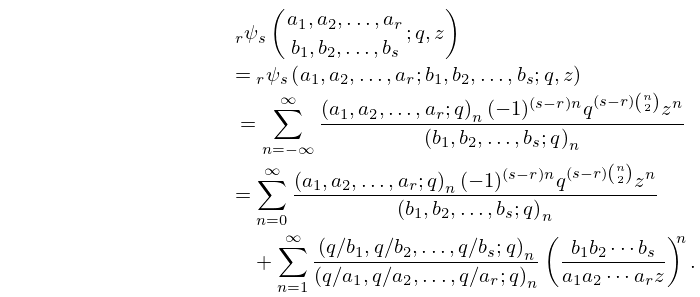
17.4.3 ψ s r ( a 1 , a 2 , , a r b 1 , b 2 , , b s ; q , z ) = ψ s r ( a 1 , a 2 , , a r ; b 1 , b 2 , , b s ; q , z ) = n = ( a 1 , a 2 , , a r ; q ) n ( 1 ) ( s r ) n q ( s r ) ( n 2 ) z n ( b 1 , b 2 , , b s ; q ) n = n = 0 ( a 1 , a 2 , , a r ; q ) n ( 1 ) ( s r ) n q ( s r ) ( n 2 ) z n ( b 1 , b 2 , , b s ; q ) n + n = 1 ( q / b 1 , q / b 2 , , q / b s ; q ) n ( q / a 1 , q / a 2 , , q / a r ; q ) n ( b 1 b 2 b s a 1 a 2 a r z ) n .
6: 16.4 Argument Unity
§16.4(v) Bilateral Series
Denote, formally, the bilateral hypergeometric function
16.4.16 H q p ( a 1 , , a p b 1 , , b q ; z ) = k = ( a 1 ) k ( a p ) k ( b 1 ) k ( b q ) k z k .
This is Dougall’s bilateral sum; see Andrews et al. (1999, §2.8).
7: 15.4 Special Cases
Dougall’s Bilateral Sum
8: 18.12 Generating Functions
See §18.18(vii) for Poisson kernels; these are special cases of bilateral generating functions.
9: Errata
  • Equation (17.10.6)
    17.10.6 ( a q / b , a q / c , a q / d , a q / e , a q / f , q / ( a b ) , q / ( a c ) , q / ( a d ) , q / ( a e ) , q / ( a f ) ; q ) ( a g , a h , a k , g / a , h / a , k / a , q a 2 , q / a 2 ; q ) ψ 10 10 ( q a , q a , b a , c a , d a , e a , f a , g a , h a , k a a , a , a q / b , a q / c , a q / d , a q / e , a q / f , a q / g , a q / h , a q / k ; q , q 3 b c d e f g h k ) = ( q , q / ( b g ) , q / ( c g ) , q / ( d g ) , q / ( e g ) , q / ( f g ) , q g / b , q g / c , q g / d , q g / e , q g / f ; q ) ( g h , g k , h / g , k / g , a g , q / ( a g ) , g / a , a q / g , q g 2 ; q ) ϕ 9 10 ( g 2 , q g , q g , g b , g c , g d , g e , g f , g h , g k g , g , q g / b , q g / c , q g / d , q g / e , q g / f , q g / h , q g / k ; q , q 3 b c d e f g h k ) + idem ( g ; h , k )

    In the numerator of the argument of the basic bilateral hypergeometric function ψ 10 10 and in the numerator of the arguments of the basic hypergeometric ϕ 9 10 functions, we replaced q 2 by q 3 . We also added a missing factor 1 / ( k / g ; q ) in the first term on the right-hand side.