arithmetic mean

AdvancedHelp

(0.001 seconds)

1—10 of 13 matching pages

1: 19.8 Quadratic Transformations
… ►
§19.8(i) Gauss’s Arithmetic-Geometric Mean (AGM)
… ►As n → ∞ , a n and g n converge to a common limit M ⁡ ( a 0 , g 0 ) called the AGM (Arithmetic-Geometric Mean) of a 0 and g 0 . …showing that the convergence of c n to 0 and of a n and g n to M ⁡ ( a 0 , g 0 ) is quadratic in each case. … ► … ►Again, p n and ε n converge quadratically to M ⁡ ( a 0 , g 0 ) and 0, respectively, and Q n converges to 0 faster than quadratically. …
2: 22.20 Methods of Computation
… ►
§22.20(ii) Arithmetic-Geometric Mean
… ►Then as n → ∞ sequences { a n } , { b n } converge to a common limit M = M ⁡ ( a 0 , b 0 ) , the arithmetic-geometric mean of a 0 , b 0 . … ►
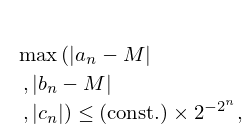
22.20.2 max ⁡ ( | a n − M | , | b n − M | , | c n | ) ≤ (const.) × 2 − 2 n ,
… ►
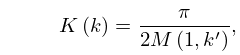
K ⁡ = π 2 ⁢ M ⁡ ( 1 , k ′ ) ,
►
K ′ ⁡ = π 2 ⁢ M ⁡ ( 1 , k ) ,
…
3: 19.22 Quadratic Transformations
… ►
§19.22(ii) Gauss’s Arithmetic-Geometric Mean (AGM)
►The AGM, M ⁡ ( a 0 , g 0 ) , of two positive numbers a 0 and g 0 is defined in §19.8(i). … ► ►
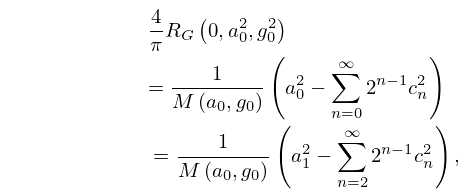
19.22.9 4 π ⁢ R G ⁡ ( 0 , a 0 2 , g 0 2 ) = 1 M ⁡ ( a 0 , g 0 ) ⁢ ( a 0 2 − ∑ n = 0 ∞ 2 n − 1 ⁢ c n 2 ) = 1 M ⁡ ( a 0 , g 0 ) ⁢ ( a 1 2 − ∑ n = 2 ∞ 2 n − 1 ⁢ c n 2 ) ,
… ►As n → ∞ , p n and ε n converge quadratically to M ⁡ ( a 0 , g 0 ) and 0, respectively, and Q n converges to 0 faster than quadratically. …
4: 1.7 Inequalities
… ►
§1.7(iii) Means
… ►
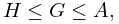
1.7.7 H ≤ G ≤ A ,
…
5: 23.22 Methods of Computation
… ►
  • (a)

    In the general case, given by c ⁢ d ≠ 0 , we compute the roots α , β , γ , say, of the cubic equation 4 ⁢ t 3 − c ⁢ t − d = 0 ; see §1.11(iii). These roots are necessarily distinct and represent e 1 ⁡ , e 2 ⁡ , e 3 ⁡ in some order.

    If c and d are real, and the discriminant is positive, that is c 3 − 27 ⁢ d 2 > 0 , then e 1 ⁡ , e 2 ⁡ , e 3 ⁡ can be identified via (23.5.1), and k 2 , k ′ 2 obtained from (23.6.16).

    If c 3 − 27 ⁢ d 2 < 0 , or c and d are not both real, then we label α , β , γ so that the triangle with vertices α , β , γ is positively oriented and [ α , γ ] is its longest side (chosen arbitrarily if there is more than one). In particular, if α , β , γ are collinear, then we label them so that β is on the line segment ( α , γ ) . In consequence, k 2 = ( β − γ ) / ( α − γ ) , k ′ 2 = ( α − β ) / ( α − γ ) satisfy ℑ ⁡ k 2 ≥ 0 ≥ ℑ ⁡ k ′ 2 (with strict inequality unless α , β , γ are collinear); also | k 2 | , | k ′ 2 | ≤ 1 .

    Finally, on taking the principal square roots of k 2 and k ′ 2 we obtain values for k and k ′ that lie in the 1st and 4th quadrants, respectively, and 2 ⁢ ω 1 , 2 ⁢ ω 3 are given by

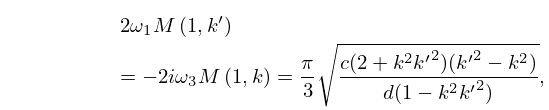
    23.22.1 2 ⁢ ω 1 ⁢ M ⁡ ( 1 , k ′ ) = − 2 ⁢ i ⁢ ω 3 ⁢ M ⁡ ( 1 , k ) = π 3 ⁢ c ⁢ ( 2 + k 2 ⁢ k ′ 2 ) ⁢ ( k ′ 2 − k 2 ) d ⁢ ( 1 − k 2 ⁢ k ′ 2 ) ,

    where M denotes the arithmetic-geometric mean (see §§19.8(i) and 22.20(ii)). This process yields 2 possible pairs ( 2 ⁢ ω 1 , 2 ⁢ ω 3 ), corresponding to the 2 possible choices of the square root.

  • …
    6: 1.2 Elementary Algebra
    … ►
    §1.2(iv) Means
    ►The arithmetic mean of n numbers a 1 , a 2 , … , a n is ►
    1.2.17 A = a 1 + a 2 + ⋯ + a n n .
    … ►
    M ⁡ ( 1 ) = A ,
    …
    7: 15.17 Mathematical Applications
    … ►Quadratic transformations give insight into the relation of elliptic integrals to the arithmetic-geometric mean (§19.22(ii)). … …
    8: Bibliography C
    … ►
  • D. A. Cox (1984) The arithmetic-geometric mean of Gauss. Enseign. Math. (2) 30 (3-4), pp. 275–330.
  • ►
  • D. A. Cox (1985) Gauss and the arithmetic-geometric mean. Notices Amer. Math. Soc. 32 (2), pp. 147–151.
  • …
    9: Bibliography
    … ►
  • G. Almkvist and B. Berndt (1988) Gauss, Landen, Ramanujan, the arithmetic-geometric mean, ellipses, π , and the Ladies Diary. Amer. Math. Monthly 95 (7), pp. 585–608.
  • …
    10: Bibliography S
    … ►
  • K. L. Sala (1989) Transformations of the Jacobian amplitude function and its calculation via the arithmetic-geometric mean. SIAM J. Math. Anal. 20 (6), pp. 1514–1528.
  • …