A plane partition, , of a positive integer , is a partition of in which the parts have been arranged in a 2-dimensional array that is weakly decreasing (nonincreasing) across rows and down columns. Different configurations are counted as different plane partitions. As an example, there are six plane partitions of 3:
| 26.12.1 | , | ||
| , | |||
| , | |||
| , | |||
| , | |||
| . | |||
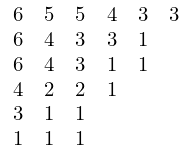
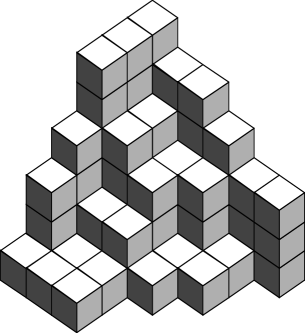
An equivalent definition is that a plane partition is a finite subset of with the property that if and , then must be an element of . Here means , , and . It is useful to be able to visualize a plane partition as a pile of blocks, one block at each lattice point . For example, Figure 26.12.1 depicts the pile of blocks that represents the plane partition of 75 given by (26.12.2).
| 26.12.2 | |||
The number of plane partitions of is denoted by , with . See Table 26.12.1.
| 0 | 1 | 17 | 18334 | 34 | 281 75955 |
|---|---|---|---|---|---|
| 1 | 1 | 18 | 29601 | 35 | 416 91046 |
| 2 | 3 | 19 | 47330 | 36 | 614 84961 |
| 3 | 6 | 20 | 75278 | 37 | 903 79784 |
| 4 | 13 | 21 | 1 18794 | 38 | 1324 41995 |
| 5 | 24 | 22 | 1 86475 | 39 | 1934 87501 |
| 6 | 48 | 23 | 2 90783 | 40 | 2818 46923 |
| 7 | 86 | 24 | 4 51194 | 41 | 4093 83981 |
| 8 | 160 | 25 | 6 96033 | 42 | 5930 01267 |
| 9 | 282 | 26 | 10 68745 | 43 | 8566 67495 |
| 10 | 500 | 27 | 16 32658 | 44 | 12343 63833 |
| 11 | 859 | 28 | 24 83234 | 45 | 17740 79109 |
| 12 | 1479 | 29 | 37 59612 | 46 | 25435 35902 |
| 13 | 2485 | 30 | 56 68963 | 47 | 36379 93036 |
| 14 | 4167 | 31 | 85 12309 | 48 | 51913 04973 |
| 15 | 6879 | 32 | 127 33429 | 49 | 73910 26522 |
| 16 | 11297 | 33 | 189 74973 | 50 | 1 04996 40707 |
We define the box as
| 26.12.3 | |||
|
ⓘ
| |||
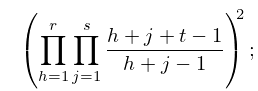
Then the number of plane partitions in is
| 26.12.4 | |||
|
ⓘ
| |||
A plane partition is symmetric if implies that . The number of symmetric plane partitions in is
| 26.12.5 | |||
|
ⓘ
| |||
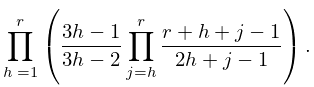
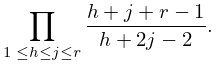
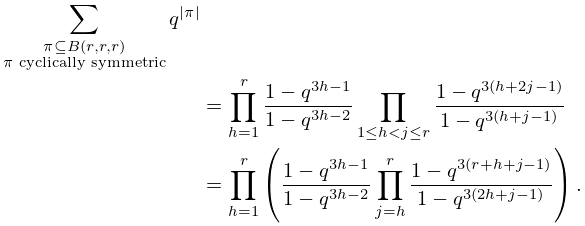
A plane partition is cyclically symmetric if implies . The plane partition in Figure 26.12.1 is an example of a cyclically symmetric plane partition. The number of cyclically symmetric plane partitions in is
| 26.12.6 | |||
|
ⓘ
| |||
or equivalently,
| 26.12.7 | |||
|
ⓘ
| |||
A plane partition is totally symmetric if it is both symmetric and cyclically symmetric. The number of totally symmetric plane partitions in is
| 26.12.8 | |||
|
ⓘ
| |||
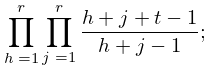
The complement of is . A plane partition is self-complementary if it is equal to its complement. The number of self-complementary plane partitions in is
| 26.12.9 | |||
|
ⓘ
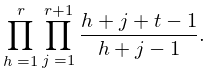
| |||
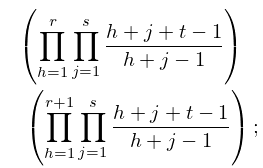
in it is
| 26.12.10 | |||
|
ⓘ
| |||
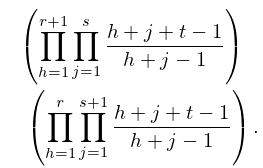
in it is
| 26.12.11 | |||
|
ⓘ
| |||
A plane partition is transpose complement if it is equal to the reflection through the -plane of its complement. The number of transpose complement plane partitions in is
| 26.12.12 | |||
|
ⓘ
| |||
The number of symmetric self-complementary plane partitions in is
| 26.12.13 | |||
|
ⓘ
| |||
in it is
| 26.12.14 | |||
|
ⓘ
| |||
The number of cyclically symmetric transpose complement plane partitions in is
| 26.12.15 | |||
|
ⓘ
| |||
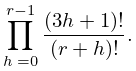
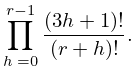
The number of cyclically symmetric self-complementary plane partitions in is
| 26.12.16 | |||
|
ⓘ
| |||
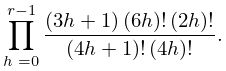
The number of totally symmetric self-complementary plane partitions in is
| 26.12.17 | |||
|
ⓘ
| |||
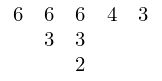
A strict shifted plane partition is an arrangement of the parts in a partition so that each row is indented one space from the previous row and there is weak decrease across rows and strict decrease down columns. An example is given by:
| 26.12.18 | |||
A descending plane partition is a strict shifted plane partition in which the number of parts in each row is strictly less than the largest part in that row and is greater than or equal to the largest part in the next row. The example of a strict shifted plane partition also satisfies the conditions of a descending plane partition. The number of descending plane partitions in is
| 26.12.19 | |||
|
ⓘ
| |||
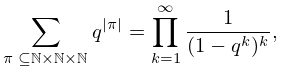
The notation denotes the sum over all plane partitions contained in , and denotes the number of elements in .
| 26.12.20 | |||
|
ⓘ
| |||
| 26.12.21 | |||
|
ⓘ
| |||
| 26.12.22 | |||
|
ⓘ
| |||
| 26.12.23 | |||
|
ⓘ
| |||
| 26.12.24 | |||
|
ⓘ
| |||
| 26.12.25 | |||
|
ⓘ
| |||
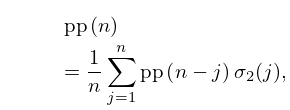
where is the sum of the squares of the divisors of .
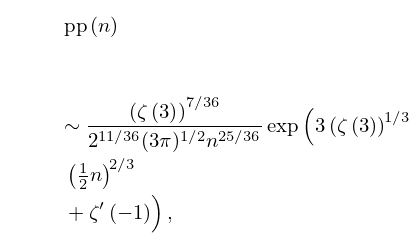
As
| 26.12.26 | |||
|
ⓘ
| |||
where is the Riemann -function (§25.2(i)).
Addendum: To ten decimal places,
| 26.12.27 | ||||
|
ⓘ
| ||||