§4.12 Generalized Logarithms and Exponentials
A generalized exponential function satisfies the equations
| 4.12.1 | ||||
| , | ||||
| 4.12.2 | ||||
and is strictly increasing when . Its inverse is called a generalized logarithm. It, too, is strictly increasing when , and
| 4.12.3 | ||||
| , | ||||
| 4.12.4 | ||||
These functions are not unique. The simplest choice is given by
| 4.12.5 | |||
| . | |||
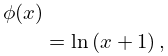
Then
| 4.12.6 | |||
| , | |||
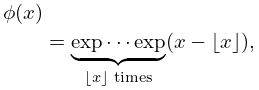
and
| 4.12.7 | |||
| . | |||
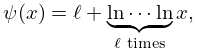
Correspondingly,
| 4.12.8 | |||
| , | |||
and
| 4.12.9 | |||
| , | |||
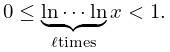
where is the positive integer determined by the condition
| 4.12.10 | |||
Both and are continuously differentiable.