Digital Library of Mathematical Functions
About the Project
NIST
32 Painlevé TranscendentsApplications

§32.14 Combinatorics

Let S_{N} be the group of permutations \boldsymbol{\pi} of the numbers 1,2,\dots,N26.2). With 1\leq m_{1}<\dots<m_{n}\leq N, \boldsymbol{\pi}(m_{1}),\boldsymbol{\pi}(m_{2}),\dots,\boldsymbol{\pi}(m_{n}) is said to be an increasing subsequence of \boldsymbol{\pi} of length n when \boldsymbol{\pi}(m_{1})<\boldsymbol{\pi}(m_{2})<\dots<\boldsymbol{\pi}(m_{n}). Let \ell_{N}(\boldsymbol{\pi}) be the length of the longest increasing subsequence of \boldsymbol{\pi}. Then

where the distribution function F(s) is defined here by

and w(x) satisfies \mbox{P}_{{\mbox{\scriptsize II}}} with \alpha=0 and boundary conditions

32.14.3w(x)\sim\mathop{\mathrm{Ai}\/}\nolimits\!\left(x\right),x\to+\infty,
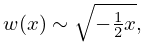
32.14.4w(x)\sim\sqrt{-\tfrac{1}{2}x},x\to-\infty,

where \mathop{\mathrm{Ai}\/}\nolimits denotes the Airy function (§9.2).

The distribution function F(s) given by (32.14.2) arises in random matrix theory where it gives the limiting distribution for the normalized largest eigenvalue in the Gaussian Unitary Ensemble of n\times n Hermitian matrices; see Tracy and Widom (1994).

See Forrester and Witte (2001, 2002) for other instances of Painlevé equations in random matrix theory.