§20.13 Physical Applications
The functions , , provide periodic solutions of the partial differential equation
| 20.13.1 | |||
with .
For , with real, (20.13.1) takes the form of a real-time diffusion equation
| 20.13.2 | |||
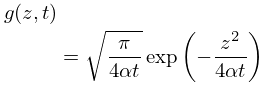
with diffusion constant . Let . Then the nonperiodic Gaussian
| 20.13.3 | |||
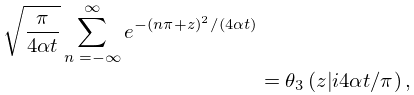
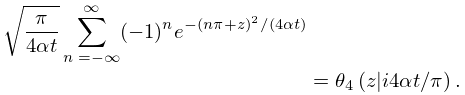
is also a solution of (20.13.2), and it approaches a Dirac delta (§1.17) at . These two apparently different solutions differ only in their normalization and boundary conditions. From (20.2.3), (20.2.4), (20.7.32), and (20.7.33),
| 20.13.4 | |||
and
| 20.13.5 | |||
Thus the classical theta functions are “periodized”, or “anti-periodized”, Gaussians; see Bellman (1961, pp. 18, 19). Theta-function solutions to the heat diffusion equation with simple boundary conditions are discussed in Lawden (1989, pp. 1–3), and with more general boundary conditions in Körner (1989, pp. 274–281).
In the singular limit , the functions , , become integral kernels of Feynman path integrals (distribution-valued Green’s functions); see Schulman (1981, pp. 194–195). This allows analytic time propagation of quantum wave-packets in a box, or on a ring, as closed-form solutions of the time-dependent Schrödinger equation.