Digital Library of Mathematical Functions
About the Project
NIST
19 Elliptic IntegralsLegendre’s Integrals19.3 Graphics

Figure 19.3.6 (See in context.)

See accompanying text
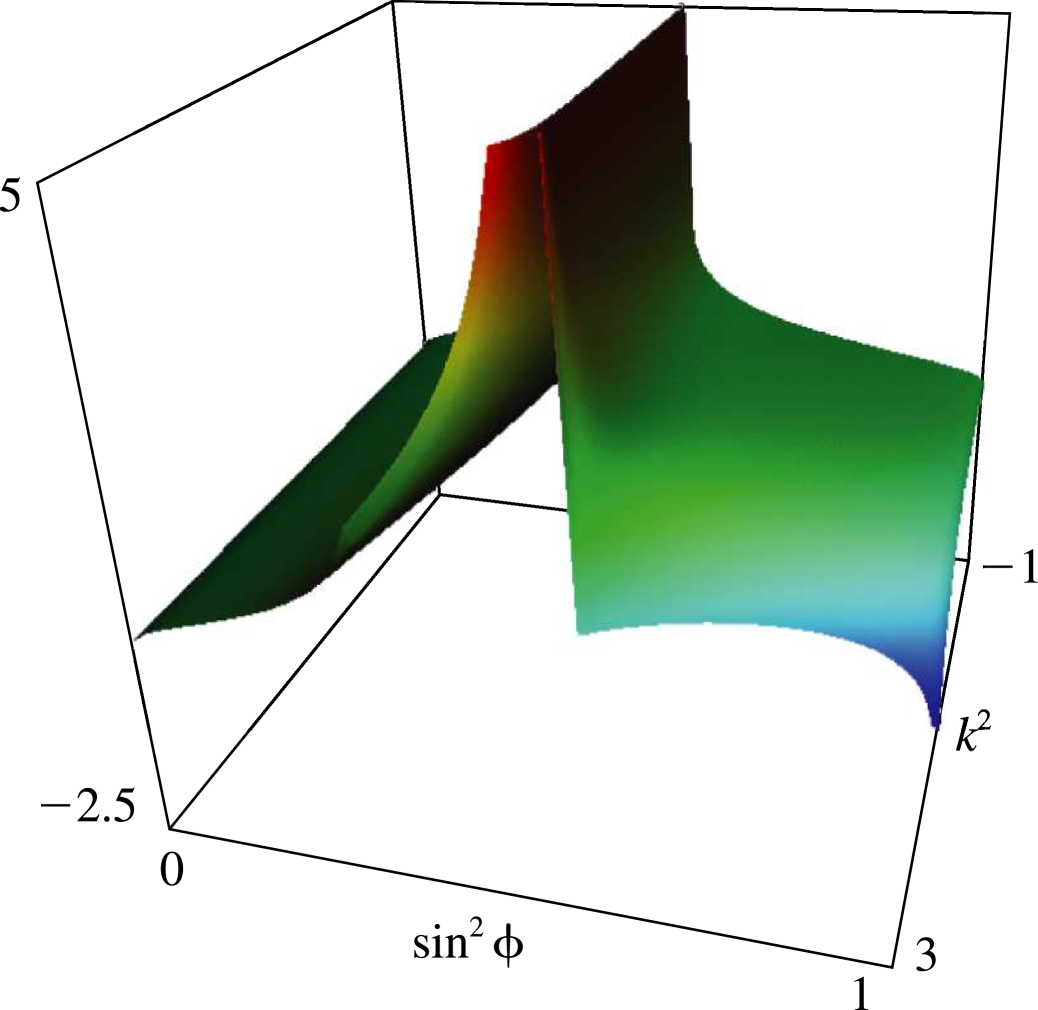
Figure 19.3.6: \mathop{\Pi\/}\nolimits\!\left(\phi,2,k\right) as a function of k^{2} and {\mathop{\sin\/}\nolimits^{{2}}}\phi for -1\leq k^{2}\leq 3, 0\leq{\mathop{\sin\/}\nolimits^{{2}}}\phi<1. Cauchy principal values are shown when {\mathop{\sin\/}\nolimits^{{2}}}\phi>\frac{1}{2}. The function tends to +\infty as {\mathop{\sin\/}\nolimits^{{2}}}\phi\to\frac{1}{2}, except in the last case below. If {\mathop{\sin\/}\nolimits^{{2}}}\phi=1 (>k^{2}), then the function reduces to \mathop{\Pi\/}\nolimits\!\left(2,k\right) with Cauchy principal value \mathop{K\/}\nolimits\!\left(k\right)-\mathop{\Pi\/}\nolimits\!\left(\frac{1}{%
2}k^{2},k\right), which tends to -\infty as k^{2}\to 1-. See (19.6.5) and (19.6.6). If {\mathop{\sin\/}\nolimits^{{2}}}\phi=1/k^{2} (<1), then by (19.7.4) it reduces to \mathop{\Pi\/}\nolimits\!\left(2/k^{2},1/k\right)/k, k^{2}\neq 2, with Cauchy principal value (\mathop{K\/}\nolimits\!\left(1/k\right)-\mathop{\Pi\/}\nolimits\!\left(\frac{%
1}{2},1/k\right))/k, 1<k^{2}<2, by (19.6.5). Its value tends to -\infty as k^{2}\to 1+ by (19.6.6), and to the negative of the second lemniscate constant (see (19.20.22)) as k^{2}(={\mathop{\csc\/}\nolimits^{{2}}}\phi)\to 2-.