Digital Library of Mathematical Functions
About the Project
NIST
18 Orthogonal PolynomialsOther Orthogonal Polynomials

§18.37 Classical OP’s in Two or More Variables

Contents

§18.37(i) Disk Polynomials

Definition in Terms of Jacobi Polynomials

Equivalent Definition

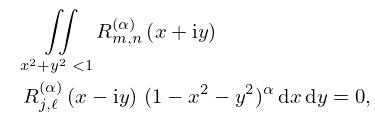
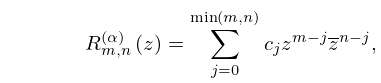
The following three conditions, taken together, determine \mathop{R^{{(\alpha)}}_{{m,n}}\/}\nolimits\!\left(z\right) uniquely:

where c_{j} are real or complex constants, with c_{0}\neq 0;

§18.37(ii) OP’s on the Triangle

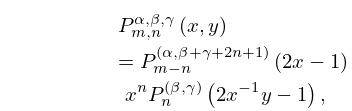
Definition in Terms of Jacobi Polynomials

18.37.7\mathop{P^{{\alpha,\beta,\gamma}}_{{m,n}}\/}\nolimits\!\left(x,y\right)=%
\mathop{P^{{(\alpha,\beta+\gamma+2n+1)}}_{{m-n}}\/}\nolimits\!\left(2x-1\right%
)\*x^{n}\mathop{P^{{(\beta,\gamma)}}_{{n}}\/}\nolimits\!\left(2x^{{-1}}y-1%
\right),m\geq n\geq 0, \alpha,\beta,\gamma>-1.

Orthogonality

See Dunkl and Xu (2001, §2.3.3) for analogs of (18.37.1) and (18.37.7) on a d-dimensional simplex.

§18.37(iii) OP’s Associated with Root Systems

Orthogonal polynomials associated with root systems are certain systems of trigonometric polynomials in several variables, symmetric under a certain finite group (Weyl group), and orthogonal on a torus. In one variable they are essentially ultraspherical, Jacobi, continuous q-ultraspherical, or Askey–Wilson polynomials. In several variables they occur, for q=1, as Jack polynomials and also as Jacobi polynomials associated with root systems; see Macdonald (1995, Chapter VI, §10), Stanley (1989), Kuznetsov and Sahi (2006, Part 1), Heckman (1991). For general q they occur as Macdonald polynomials for root system A_{n}, as Macdonald polynomials for general root systems, and as Macdonald-Koornwinder polynomials; see Macdonald (1995, Chapter VI), Macdonald (2000, 2003), Koornwinder (1992).