14 Legendre and Related FunctionsComplex Arguments14.23 Values on the Cut14.25 Integral Representations
§14.24 Analytic Continuation
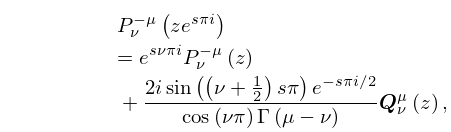
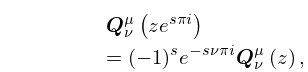
Let be an arbitrary integer, and and denote the branches obtained from the principal branches by making circuits, in the positive sense, of the ellipse having as foci and passing through . Then
| 14.24.1 | |||
| 14.24.2 | |||
the limiting value being taken in (14.24.1) when is an odd integer.
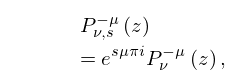
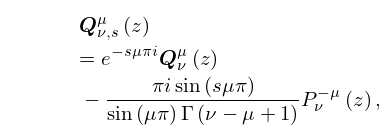
Next, let and denote the branches obtained from the principal branches by encircling the branch point (but not the branch point ) times in the positive sense. Then
| 14.24.3 | ||||
| 14.24.4 | ||||
the limiting value being taken in (14.24.4) when .
For fixed , other than or , each branch of and is an entire function of each parameter and .